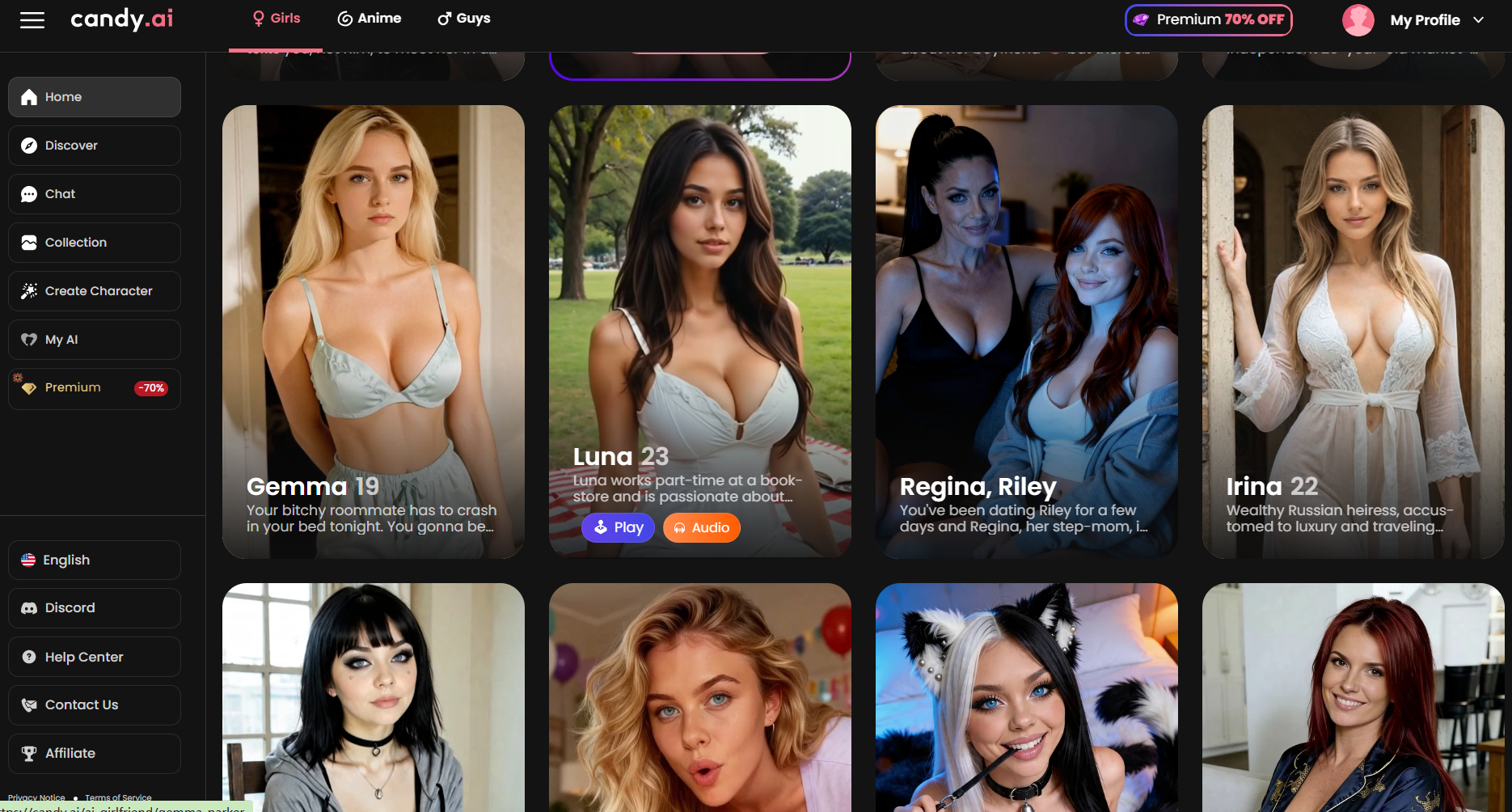
Hi everyone, today I want to walk you through Candy AI and share a product review of what it is actually doing under the hood.
What caught my attention was not a headline metric but the unusually integrated product loop: browsing characters, chatting, generating media, and returning to the same relationship state.
The more useful question is not a reported traffic number; it is whether the product holds together once you move between discovery, chat, creation, and paid media. That is the interaction path this review examines.
This review therefore focuses on the product mechanics visible in the interface, the official plan and policy pages, and the points a prospective subscriber can actually verify before paying.
So I decided to spend some time actually using the product end-to-end.
Here’s the short version: Candy AI is essentially an AI virtual companion platform. You can build a long-term conversational relationship with a virtual girlfriend or boyfriend, depending on preference.
Adult content is not incidental to the product experience, so privacy, account controls, and the cost of media generation deserve the same attention as character quality.
But the more I used it, the less I felt that label alone explained what’s actually going on. Reducing Candy AI to “just NSFW” feels like an easy answer that misses the real product logic.
Quick verdict
Best for a visual companion experience — if you budget for more than the headline plan
Candy AI feels most coherent when chat, character creation, images, voice, and Live Action are treated as one companion loop rather than as separate tools. The interface is polished and the visual layer is central to the experience. It is a better fit for people who value that format than for someone looking for a low-cost, text-only chatbot.
The main trade-off is cost clarity. A subscription includes unlimited text messages and a monthly token allowance, while media-heavy use can make the token balance the real constraint. Before paying, decide whether you mainly want conversation, character creation, or frequent image and video output; they do not put the same pressure on the allowance.
Good fit
You want a companion product where visual identity, character creation, chat, voice, and generated media belong to the same account and interaction flow.
Think twice
You need one predictable all-inclusive price, prefer a strictly text-only experience, or do not want sensitive prompts and generated media associated with an account.
The Core Idea: Relationship Progress as a Multimodal System
The design makes one thing very explicit: your relationship with each AI character has progression.
That progression is tracked, updated, and most importantly, expressed through multimodal outputs—especially video.
Text, voice, images, and video are all tied to the same underlying relationship state.
I started thinking of this as a kind of “multimodal progression system.”
Why It Works: Turning Emotion Into a Structured Loop
The key innovation is not content—it’s structure.
Emotional relationships, which are usually fuzzy and subjective, are turned into something that is:
- visible
- progressive
- unlock-based
- and monetizable
And the feedback mechanism is not text—it’s video.
The product’s commercial design is easy to see in the interface: relationship progression, media generation, and unlock states are connected to a subscription-plus-token model. That makes the cost of the specific workflow more important than broad claims about the company’s scale.
For a prospective user, the practical question is simpler: does the character and media experience justify the recurring plan and the token budget for the way you will use it?
The First Impression: NSFW Warning, Then a “Live Platform” Feel
The first thing you see is a large NSFW warning. The entire interface feels closer to a live streaming platform than a traditional AI app.
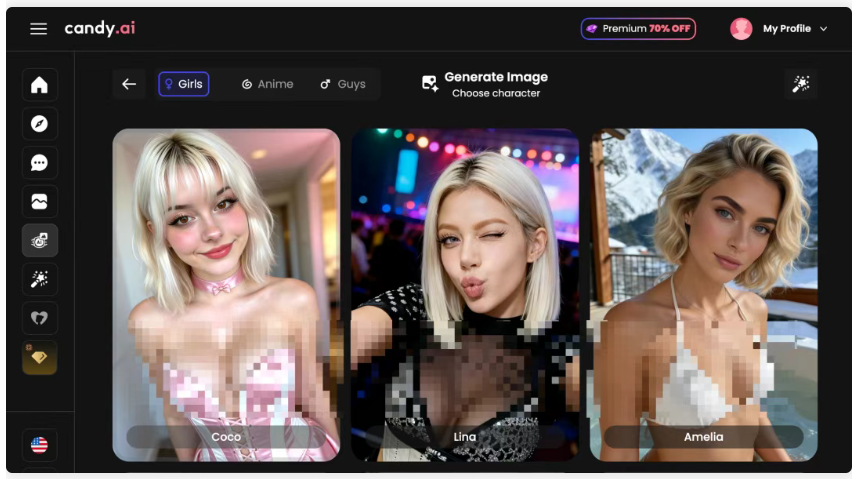
The character library is extensive and heavily female-dominated, with surprisingly polished visual quality—faces, lighting, and styling are all relatively refined.
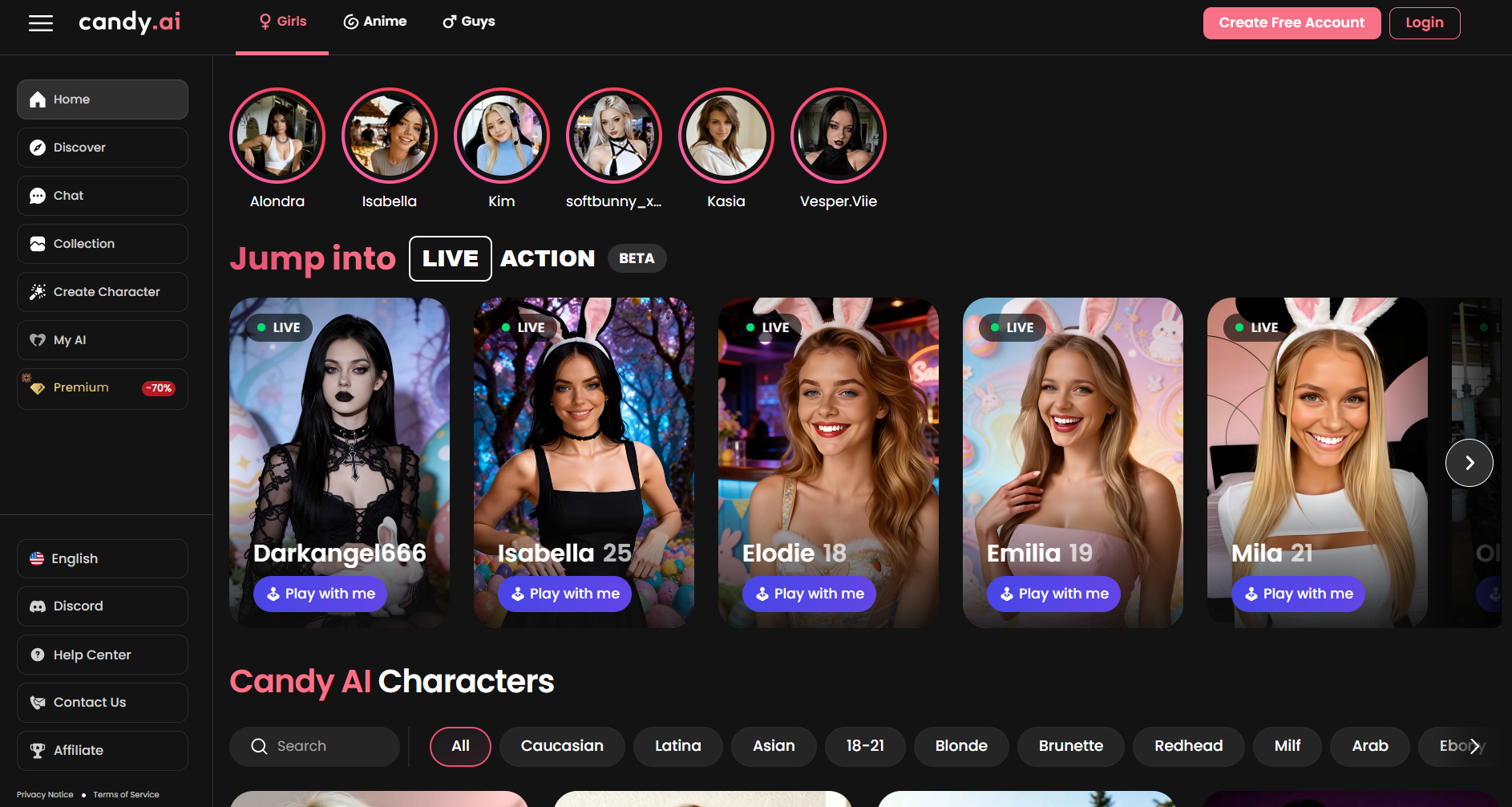
A small but important detail: hovering over a character card triggers motion playback directly on the card itself—short AI-generated video clips instead of static previews.
Discover Feed: Designed Like TikTok, Not a Catalog
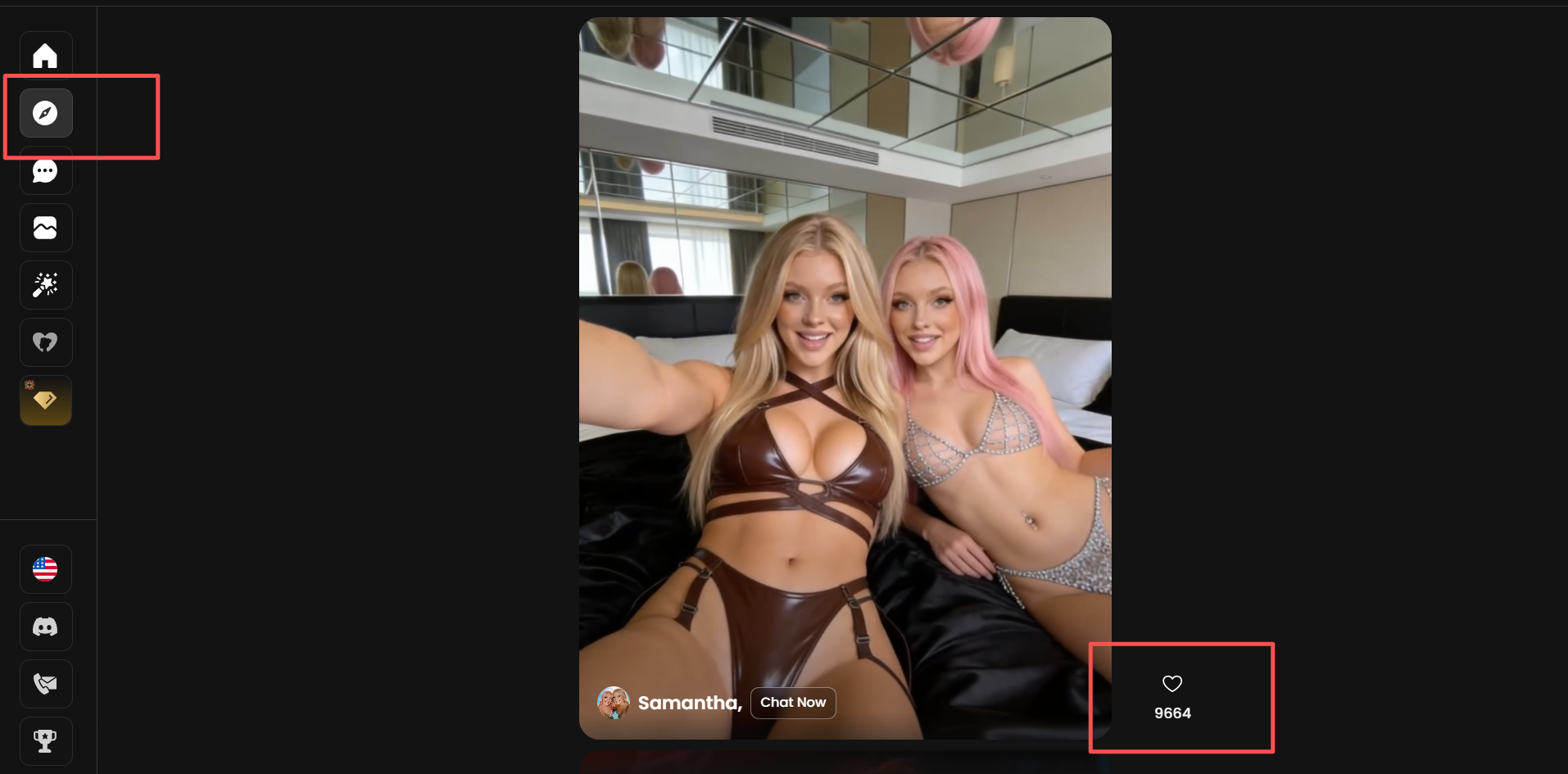
The “Discover” section doesn’t behave like a list of profiles.
Instead, it’s a vertical, TikTok-style feed. You swipe, and the next character appears in motion.
This matters more than it looks. In AI companion products, layout decisions directly shape perceived intent. The UI is not neutral—it guides emotional framing.
Chat UI: The Shift Away From “Chat-Centric Design”
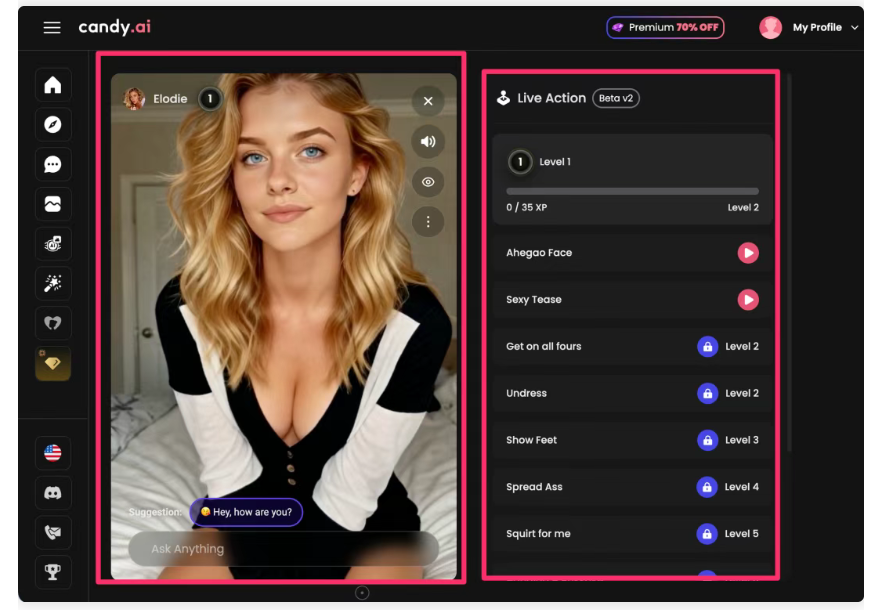
The chat interface is split into two main areas. But the right side dominates visually.
Nearly half the screen is dedicated to something called “Live Action.”
This is essentially a multimodal action layer: video reactions, animated responses, and contextual visual outputs tied to the conversation.
In practice, chatting becomes secondary. The experience starts feeling more like a light interactive game where conversation is just one trigger among many.
Unlock System: Locked UI States and Progressive Intimacy
The progression system is extremely explicit.
Early on, many actions are locked. Buttons are visible but unclickable.
Once certain conversational conditions are met, those actions unlock. When you click the playback button, the left panel immediately starts playing a video response.
No transition, no delay—just direct playback of multimodal content.
Two small but important details:
- The videos include audio, not silent loops.
- They can be replayed without re-triggering the interaction flow.
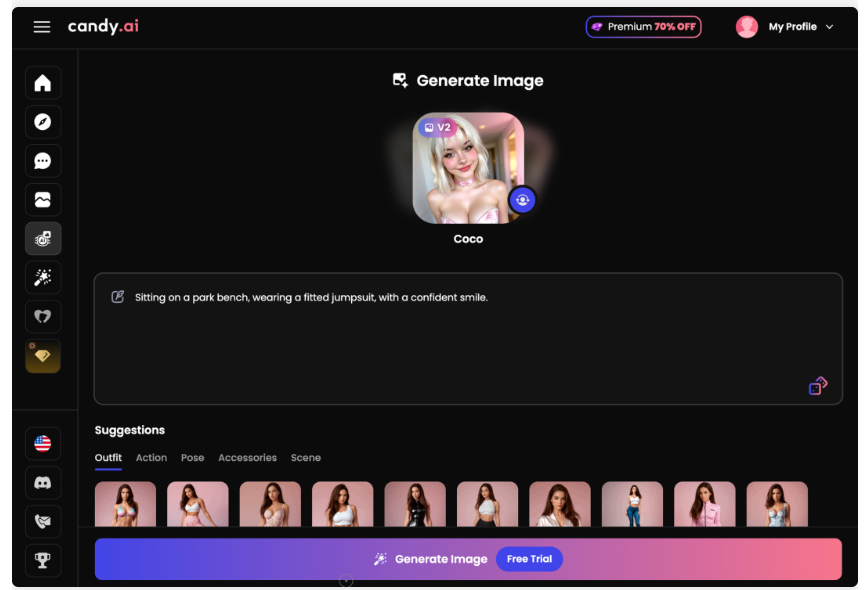
Generation Layer: Prompt-Driven but UI-Guided
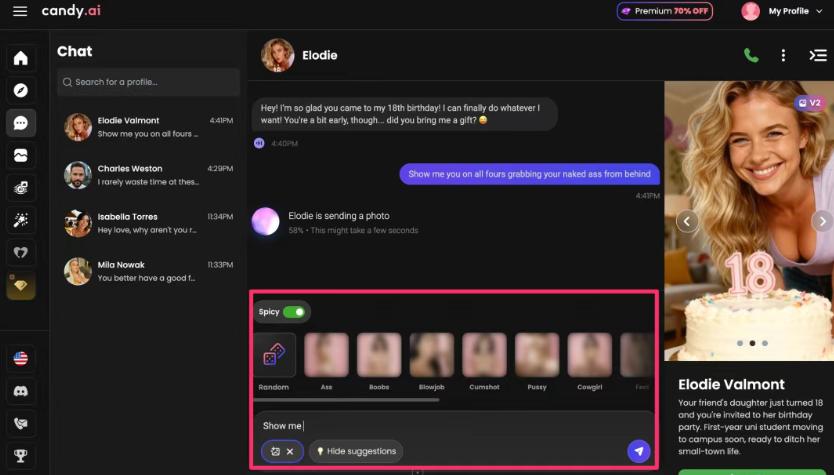
Inside chat, users also get direct access to image and video generation tools.
A “Spicy” toggle increases intensity and adjusts the generated prompts automatically.
Each selection is converted into a structured prompt and inserted into the generation field, though users can still modify it manually before execution.
Monetization Loop: Partial Output, Then Unlock
Generated images are initially blurred or partially masked. You can see composition and posture, but not full detail.
At that point, the system offers a clear choice:
Either continue interacting to increase relationship depth, or pay to instantly unlock the full-resolution content.
Character-Level Variation: Not a Shared System
One subtle but important design choice: not all characters share the same behavior system.
Each AI persona has its own progression path, content style, and behavioral thresholds.
Some characters unlock faster, some feel more restrained, others lean more aggressively into expressive outputs.
Collections: Passive Memory of Generated Content
Everything generated during interaction is automatically stored in a “Collection” module.
This acts as a persistent memory layer, reinforcing continuity and ownership over generated outputs.
Character Creation: Visual First, Text Second
The character creation flow is also consistent with the rest of the product philosophy.
Instead of starting with long text prompts, it begins visually.
The first decision is simple: realistic or anime style.

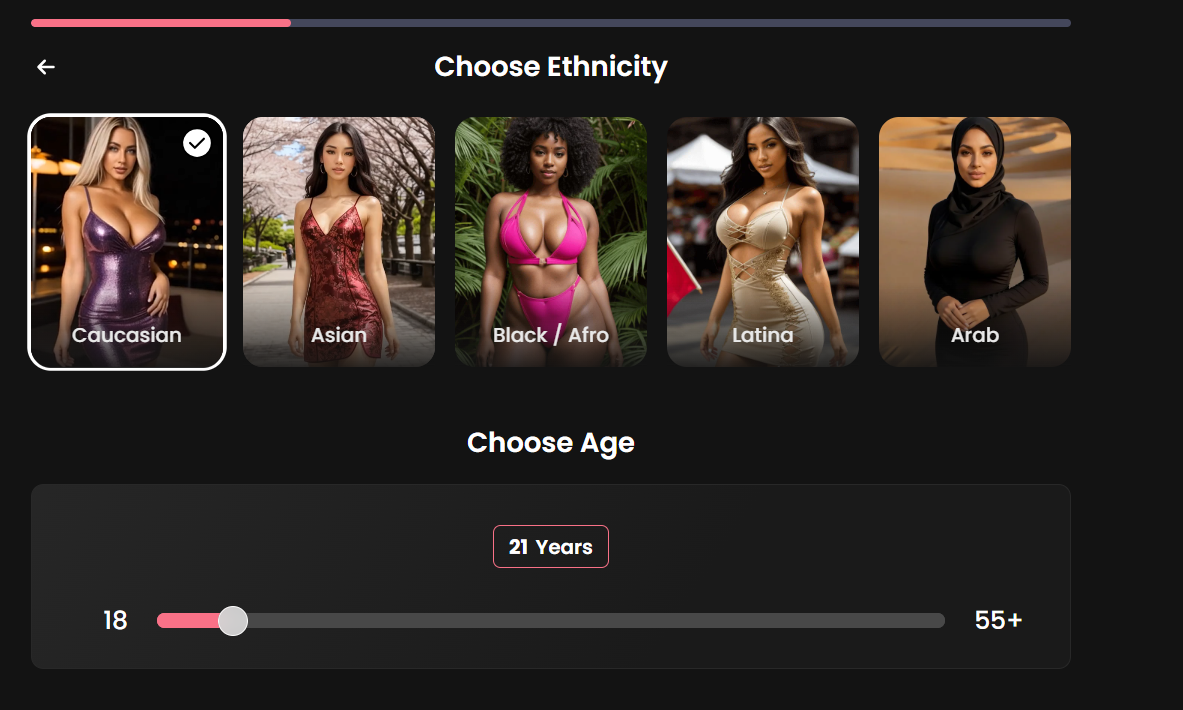
From there, users select attributes like age range and ethnicity, followed by physical features such as body shape and proportions.
Only after that do more traditional fields like personality and occupation appear.
What Candy AI Actually Built
When you connect all of this—the feed, chat, unlock system, generation tools, and character creation—you see a consistent logic.
Candy AI is not just a chatbot. It is a system for constructing emotional progression through multimodal feedback loops.
Text, images, and video are not separate features. They are synchronized layers of a single relationship state.
Why This Matters Beyond NSFW
If you strip away the NSFW layer entirely, the underlying structure still works.
The real innovation is not content—it’s the system design: turning emotional progression into something visible, unlockable, and economically structured.
This pattern will likely extend far beyond adult products into games, virtual characters, AI NPCs, and mainstream companion systems.
Pricing and value check
What the plan price covers — and what to verify before checkout
The official subscription screen currently lists monthly, three-month, and twelve-month options. Its terms state that these plans renew automatically for the same price and term unless cancelled. The displayed price is only one part of the value calculation because the plan also lists 100 tokens per month alongside unlimited text messages.
| Plan shown by Candy AI | Displayed price | What it means in practice |
|---|---|---|
| 1 month | $13.99/month | The cleanest way to test the complete experience without committing to a longer billing term. |
| 3 months | $8.99/month, $26.97 billed quarterly | A lower monthly rate, but only sensible after checking how quickly your preferred media actions use tokens. |
| 12 months | $3.99/month, $47.88 billed annually | The strongest headline discount, but it is an annual payment and auto-renews under the stated terms. |
My take: start with the shortest available term if you have not yet tested the character quality and media workflow you actually intend to use. Do not assume a low annual equivalent means unlimited image or video generation. Confirm the live token cost, taxes, cancellation path, and any promotion terms in the checkout flow before purchase; those details can change.
Privacy is part of the product decision
Candy AI’s privacy notice treats conversation inputs, generated outputs, account information, and some usage data as information processed to provide the service. It also says that interactions may be aggregated, anonymized, or de-identified for improvement, research, moderation, and quality-assurance purposes. That is not a reason to avoid the product automatically, but it is a reason to keep real names, contact details, identifying photos, and anything you would not want connected to an account out of prompts and uploads.
Final Thought
We often treat emotion as something unstructured and uncomputable.
Candy AI challenges that assumption by treating emotional relationships as a system that can be designed.
This is not the final form. It is an early but functioning example of a much larger direction.
And what we’re seeing now is probably just the beginning.
Official sources used for this review
- Candy AI subscription page — plan intervals, renewal language, included monthly tokens, and the current listed prices.
- Candy AI image generator — character-led image generation, text and voice chat, and the stated image quantity controls.
- Candy AI privacy notice — how the service describes conversation inputs, generated outputs, account data, and de-identified processing.
- Candy AI legal information — terms and the current legal/support entry points.