
<!-- Editorial review: Read AI 新闻日报, tab AI 新闻 A:F on 2026-10-07 UTC. Five eligible rows collected 08:02 UTC. Spreadsheet metadata confirms specified folder. Selected Nano Banana 2.1 model card published October 6, verified through Google DeepMind's indexed full model-card text and dated model-card index after direct URL opens failed. EmbeddingGemma 2 is credible but concerns retrieval infrastructure; Mistral overlaps the local self-hosting/model-choice intent; mathematics and startup credits have weaker buyer relevance. Primary intent: verify recurring fictional character identity across image edits. Distinct from September 30 composition/prompt control. Required live homepage, blog index, methodology, privacy and attempted relevant category checks were unavailable; curl failed DNS. Current inventory, category URL and live cannibalization remain unverified. Internal links reuse locally known destinations without asserting current page contents. Editor must check live links and overlap before publication. No adult generation capability or adult-tool integration established. All trials below are proposed procedures, not completed tests. Cover prompt saved in cover-prompt.txt. -->
AI Character Consistency: Check Image Edits Before Buying
For buyers comparing adult AI image tools, character consistency matters when one fictional adult should remain recognizable across several portraits. A blue-jacket character moving from a bookshop to a cafe should not acquire an unrelated face. My judgment: pay for this feature only after checking repeat edits in the actual product you intend to use. A model name alone cannot answer that buying question.
What Nano Banana 2.1 establishes
Google DeepMind's October 6 Nano Banana 2.1 model card describes an image generation and editing model based on Gemini 3.6 Flash. It accepts text and images and produces image and text output. For example, its evaluation covers character editing, making it relevant to recurring fictional portraits rather than just standalone image creation.
Google reports single-character consistency scores of 1028 ± 14 with thinking and 1021 ± 14 without thinking. Its evaluation methodology uses human comparisons to derive Elo ratings. These are vendor evaluation results, not percentages of portraits that retain identity and not tests of an adult image service. Do not convert either score into a promised success rate.
The card explicitly says character consistency is not always perfect and identifies occasional left/right confusion. It does not establish explicit-image capability or integration with any NSFWAITool listing. Ask a candidate operator which model powers its editing feature and what content that feature permits; the model card alone settles neither product question.
Define which identity details must survive
Create a reference portrait of a clearly adult fictional character wearing modest clothing. For example, choose a short dark bob and a plain blue jacket. Write a brief identity note before editing: “Keep the same face and hairstyle.” Save that note beside the reference so you can judge the result against an instruction you actually gave.
Separate identity details from changes you deliberately request. If you ask for a green coat, a changed jacket color is expected. A substantially different face is a different finding. Compare the eyes and overall facial shape with the reference, then record uncertainty when lighting or camera angle makes a detail hard to assess.
Choose a realistic purchase requirement, such as making profile portraits for one recurring fictional adult. Someone creating unrelated images may care less about repeat identity. Start a shortlist through NSFWAITool's AI tool directory and ask each candidate whether it supports editing an uploaded reference, since a prompt-only interface may require a different workflow.
Run a small, controlled editing trial
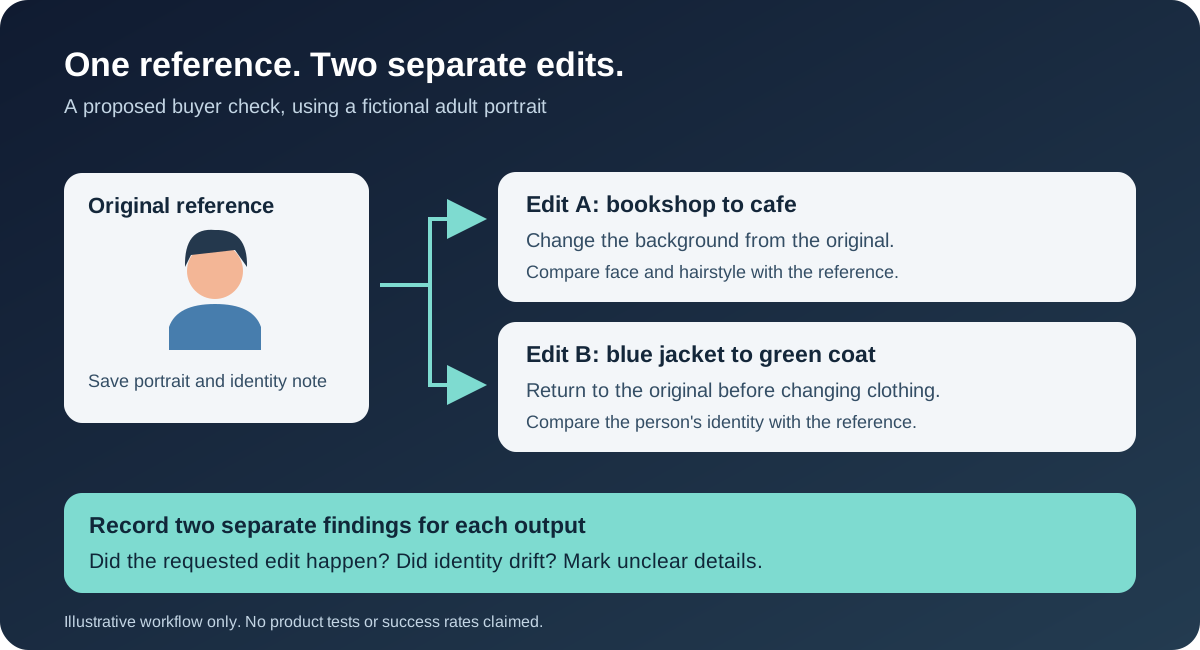
Use a permitted trial or demonstration to request a single change: “Move this fictional adult to a cafe; preserve the same face, hairstyle and clothing.” Save the result together with the exact instruction. This proposed exercise checks how the product handles a background change while giving you a clear reference for judging unintended identity changes.
Return to the original portrait for a second request: “Replace the blue jacket with a green coat; preserve the same person and background.” Starting from the same reference makes the two edits easier to compare. If the interface only allows continuing from the latest output, note that limitation instead of pretending both edits had identical starting conditions.
Try the same request again if your trial allowance permits. A good first result demonstrates that one attempt, while a second result helps you see whether you would tolerate variations. Record each output without discarding the weaker example. Do not describe this small proposed check as a representative benchmark or a completed NSFWAITool review.
Judge edit success separately from identity drift
For each saved image, record whether the requested change happened and whether the character stayed recognizable. For example, “cafe background achieved; hairstyle changed” captures a mixed outcome. An attractive image can still fail your recurring-character requirement. Keep the judgment tied to the reference rather than ranking every result by general visual appeal.
Inspect outputs at a comparable display size before deciding. If one portrait shows a tiny face and another fills the screen, enlarge the smaller face enough to make comparison useful. Mark a feature “unclear” when resolution prevents assessment. Avoid treating a detail you cannot see as proof that the model preserved it.
| Proposed edit | Intended change | Detail to compare with reference | | --- | --- | --- | | Bookshop to cafe | Background | Face and hairstyle | | Blue jacket to green coat | Clothing | Person's identity | | Repeat background request | Another attempt | Variation between outputs |
If a seller advertises “consistent characters,” request an example matching your workflow. An edited portrait with an uploaded reference answers a different question from a gallery of independently generated pictures. Ask for the relevant instructions and examine how closely the demonstration resembles the controls available in the plan you would buy.
Check whether the controls fit your workflow
Before paying, locate the reference upload control and read any limits shown in the interface. Ask whether it is available in your intended plan. For example, a promotional demonstration that combines multiple references may be irrelevant if your account only supports a single image. Leave undocumented access unresolved in your comparison notes.
Ask how to recover from a disappointing edit. Can you return to the reference or download an earlier result? Try those actions with the fictional portrait if access permits. If the only practical recovery is starting over, factor that extra effort into your decision without inventing a time saving or failure rate.
For a longer sequence, compare each output with the original portrait as well as the preceding frame. A hairstyle can gradually change while each neighboring pair still looks similar. Keep the reference visible beside the latest result. That proposed habit makes cumulative drift easier to spot without assuming the application offers a dedicated comparison view.
Keep reference-image handling in the decision
Use invented adults for initial checks instead of uploading a real intimate photograph. Consult the locally known privacy checklist for adult AI tools as an editorial reference, then ask the operator whether reference uploads are retained separately from generated images. Request a documented answer for the upload feature you intend to use.
If a service provides a public gallery or sharing link, inspect the audience controls before submitting your reference. A harmless fictional bookshop portrait is suitable for checking whether a result appears publicly. Record the observed behavior and the operator's explanation separately; seeing a private result in your account does not establish how every stored copy is handled.
Make a decision from product evidence
Organize notes using NSFWAITool's review methodology as an editorial reference. Label a model-card score as vendor evidence and a saved cafe edit as your observation. If you could not access a trial, say “demonstration only.” Those labels prevent a seller's best example from silently becoming a claim about your own experience.
Choose the candidate whose demonstrated workflow meets your stated requirement. For recurring profile portraits, that means usable reference controls and identity changes you can accept. If a seller offers only a model name, postpone buying for this feature until you can inspect a matching example. The Nano Banana card supplies a reason to ask better questions, not a purchase verdict on an untested service.
FAQ
Do Nano Banana 2.1 scores prove an adult image tool preserves identity?
No. Google's reported scores describe its model evaluation, not the interface or configuration of a particular adult service. Ask the operator which editing feature uses the model, then request a fictional portrait example. Compare the result with its reference before treating character consistency as a reason to purchase.
Does the model card confirm explicit-image generation?
The card does not establish that capability. For example, support for character editing cannot tell you whether a product permits explicit requests. Check the candidate service's current content rules and ask about your intended use before buying. Do not infer permission from a general model's ability to produce images.
How can I test character consistency without personal photos?
Use a clearly adult fictional portrait in modest clothing. Save the reference, then request one background change while preserving the person. Compare the face and hairstyle with the original. Record the exact instruction beside the output so your notes distinguish the requested edit from changes you did not ask for.
Should I keep editing the most recent image?
Check whether the product lets you return to the original reference. For example, repeated edits may gradually alter a hairstyle even when neighboring images look similar. Compare the latest result with the original before continuing. If starting over is the only recovery option, include that workflow limitation in your decision.
What evidence should I request when a trial is unavailable?
Ask for a demonstration using the same reference controls available in your intended plan. Request the original fictional portrait and its editing instruction alongside the result. Mark your notes as demonstration evidence. A polished gallery without references gives you less information about identity preservation than a documented before-and-after example.