
Berlin’s Cybrothel is often held up as a glimpse of an AI-run sex industry. The more interesting truth is that its most memorable feature may be the person you cannot see.
You can arrive without the usual front-desk conversation. The room is private. The encounter is designed to feel discreet. Then the companion speaks.
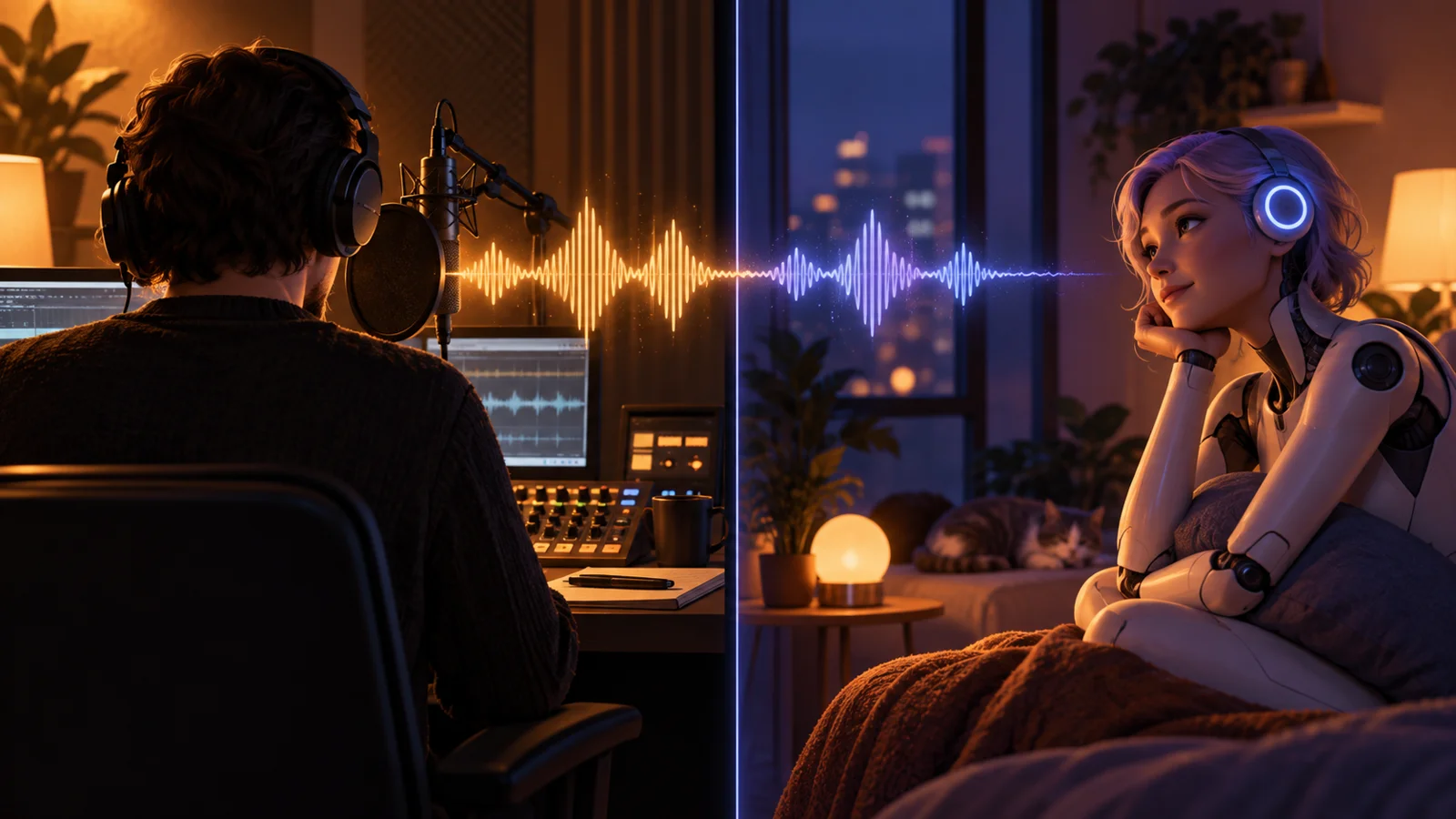
At this point, a lot of stories about Berlin’s Cybrothel jump straight to the future: the machine listens, the machine remembers, the machine replaces a person. I nearly did the same. But the venue’s own account says its interactive doll sessions can be voiced in real time by human performers. It also offers AI-related experiences, but the voice on the other end is not necessarily a language model.
That correction makes the place more interesting, not less. What looks like an automated relationship can still depend on somebody doing emotional work out of sight. And it exposes the question that will follow AI companions through the adult industry: what, exactly, are people paying to feel?
The awkward part is the point
Cybrothel describes contactless access and an anonymous guest experience. I can see the appeal without pretending everyone who books such a room is lonely or incapable of human intimacy. Sometimes people want novelty. Sometimes they want fantasy. Sometimes they want an hour without the little social negotiations that surround sex: being assessed, being recognized, having to explain themselves.
The company is selling a setting in which those negotiations feel easier. The doll is part of it; the room and the separation are part of it too. So is the voice.
The old “robots are replacing people” headline misses that last detail. In this case, the technology can make another person less visible rather than remove that person. I find that more revealing than another prediction about humanoids taking over by 2050.
Desire does not disappear. It changes its route.
There is a broader backdrop, though I would be careful with the easy “sex recession” explanation. A 2019 Washington Post analysis found that the share of US adults reporting no sex in the previous year had reached a high in 2018. That is a useful snapshot, not proof that everyone is getting lonelier each year or that an AI companion is the answer.
What seems clearer to me is that adult technology offers more routes around the same friction. A physical product can provide privacy and control. An AI character chat service can offer conversation on demand. A venue can combine a body, a room, a screen and a voice. These are not interchangeable products, and calling all of them “AI sex robots” blurs the interesting distinctions.
The upgrade is not only the body
Sex dolls have existed for decades. Conversational software changes the proposition: a companion can respond to what you say, sustain a character and, depending on the system, carry some memory into the next exchange. That is a very different promise from better silicone or warmer skin.
RealDoll now markets AI-enabled companions with customizable personalities, voice interaction and memory. Realbotix markets humanoid robots for broader human–robot interaction. Their sites illustrate two different commercial stories being told around embodiment and conversation; they should not be flattened into one product or one roadmap.
I suspect the software story will matter more than the shell in the long run. Not because a chatbot is “just as good” as a person — that is a claim I would not make — but because a recognizable voice, a remembered detail and the feeling of being attended to are what make the hardware feel like a companion rather than furniture.
And yes, that is a little bleak. Most adults could use more undivided attention from actual people. The industry has spotted the gap.
Three things the glossy demos cannot solve
The conversation still breaks. If companionship is the product, a repeated line or an implausible response lands harder than it would in an ordinary chatbot window. Character, memory and timing have to hold up over more than a polished two-minute demonstration.
The economics are not magic. Sophisticated hardware is expensive to build, maintain and repair. Cloud inference, moderation, voices and software updates create recurring costs. That does not make the category impossible; it makes the leap from an eye-catching prototype to a durable business much less glamorous.
Privacy is the real test. A companion that learns preferences and remembers intimate conversations is gathering information most people would never put in a customer-service form. The right questions are concrete: Is audio stored? Who can review a transcript? Is memory kept on-device or in the cloud? Can you delete it, and does deletion include backups? What happens if the company is sold?

Privacy promises deserve the same skepticism as any other product claim. Before sharing a face, voice or deeply personal history with a service, I would use a practical adult AI privacy checklist, not a line in a marketing page that says “anonymous” and leaves it at that.
The oldest market meets the newest interface
It is tempting to turn this into a morality play: machines are replacing love, civilization is collapsing, cue the ominous soundtrack. I do not think that tells us much. The products are too different, and the people using them have too many reasons.
The more useful question is what the technology is making easier. Sometimes the answer is fantasy. Sometimes it is distance from judgment. Sometimes it is the simple experience of being listened to, even if that attention is mediated by a room, a device or a paid performer.
Cybrothel is a good reminder not to confuse the interface with the labor behind it. Tomorrow’s companion might genuinely be an AI model. Today’s may have a human on the microphone. Either way, the selling point is not that nobody works there. It is that the customer gets to feel, for a while, as if nobody is asking anything of them.
FAQ
Is Cybrothel run entirely by AI?
No. Its own description says some interactive doll sessions use human voice actresses. The venue also offers AI-related experiences, but “contactless” does not mean “no people involved.”
What makes an AI companion different from a sex doll?
A sex doll is a physical product. An AI companion adds interactive software such as conversation, voice or memory. Some products combine both; others are entirely digital.
What should I check before using an AI companion service?
Start with the privacy policy: what audio, images and chat history are stored; whether humans can access them; how long they remain; and whether deletion really removes saved memory and backups.