Contents
- Why the Name Matters More Than It Looks
- From Reactive Chat to Proactive Assistants
- The Naming Map: Claude Duet, Grok Bot, Dot, Muse, Spark, Cue
- A Worked Morning: How a Proactive Assistant Actually Behaves
- Where the Limits Sit
- Why Claude Duet and Grok Bot Look Alike — But Are Not Interchangeable
- Common Misconceptions Worth Clearing Up
- How to Choose One Assistant to Try
- The Practical Takeaway
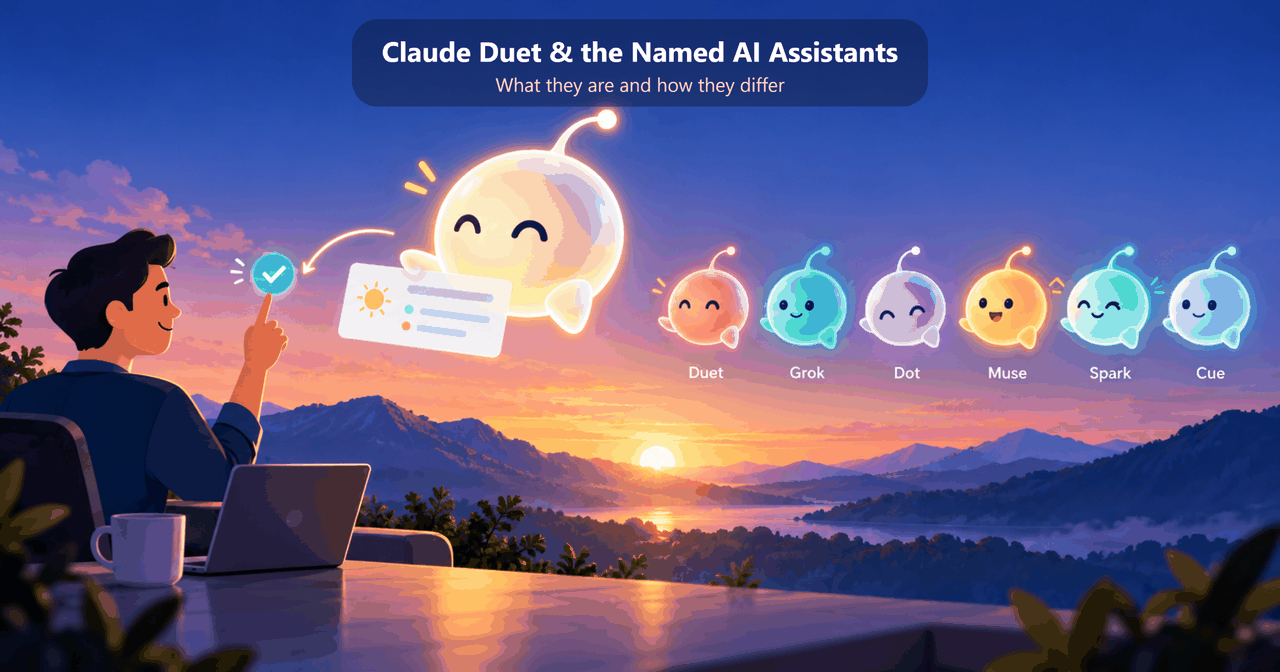
If you have seen the recent announcements and asked "what is Claude Duet?" here is the short answer: Claude Duet is Anthropic's proactive assistant app, reportedly built on the Claude Opus 5.5 model, and it represents a shift from "you ask, it answers" to "it comes to you." Instead of waiting in a chat window, it pushes a morning briefing, keeps running tasks in a cloud virtual machine, and asks for your approval before sensitive actions like sending messages, making payments, signing documents, or deleting files.
Claude Duet is not alone. Grok has its Grok bot, ChatGPT has Dot, Meta has Muse, Gemini has Spark, and Manus has Cue. Every major lab is now giving its assistant a fixed name, and the names are starting to blur together in demos. Understanding what these bots actually are — and where their boundaries sit — matters more than memorizing which name belongs to which company.
Why the Name Matters More Than It Looks
A chatbot is a window. You open it, type a question, and close it when you are done. A named assistant is positioning itself as a persistent colleague: something with a fixed identity, a memory of ongoing work, and permission to act on your behalf within limits you set.
That naming decision carries three practical consequences:
- Identity continuity. "Dot" or "Spark" becomes the surface you talk to every morning, not a generic search box that forgets your context when you close the tab.
- Permission surface. A named assistant is the entity you grant calendar access, inbox access, or payment approval to. The name is where the permission model lives.
- Expectation management. Calling something an "assistant" or a "bot" signals that it is meant to act, not just reply. That changes what you should verify before you trust it with a task.
The name is not the model. Claude Duet reportedly runs on Claude Opus 5.5, but the assistant layer — the briefing, the background execution, the approval gates — is a product built around the model, not the model itself. Treating the two as the same thing is the most common source of confusion right now.
From Reactive Chat to Proactive Assistants
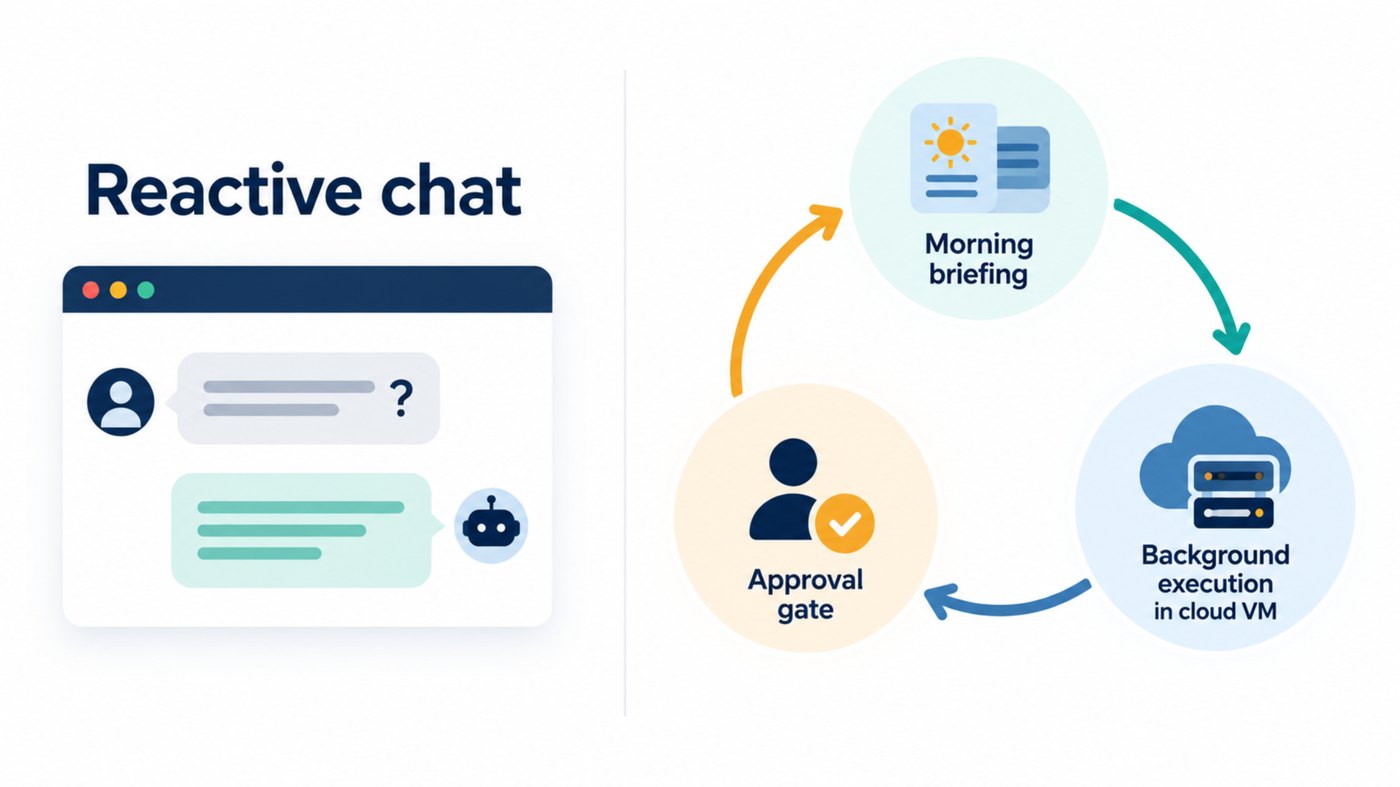
The shift breaks down into three layers that most announcements describe vaguely:
1. Briefing. The assistant greets you with a morning summary: overnight messages, calendar conflicts, pending approvals, unfinished tasks. You do not have to ask. It is the first surface you see.
2. Background execution. Long-running work happens in a cloud virtual machine rather than in the foreground of your device. Research, multi-step workflows, and monitoring tasks can continue while you do something else. The key distinction: the task runs in the cloud, not on your phone, so it does not depend on your screen staying on.
3. Approval gates. Every consequential action — sending a message on your behalf, processing a payment, applying a signature, deleting something — routes back to you for explicit approval. Proactive does not mean unsupervised. The assistant prepares the action; you authorize it.
This architecture is what separates a proactive assistant from a chatbot with a good memory. The memory is the easy part. The briefing loop and the approval system are the product.
The Naming Map: Claude Duet, Grok Bot, Dot, Muse, Spark, Cue
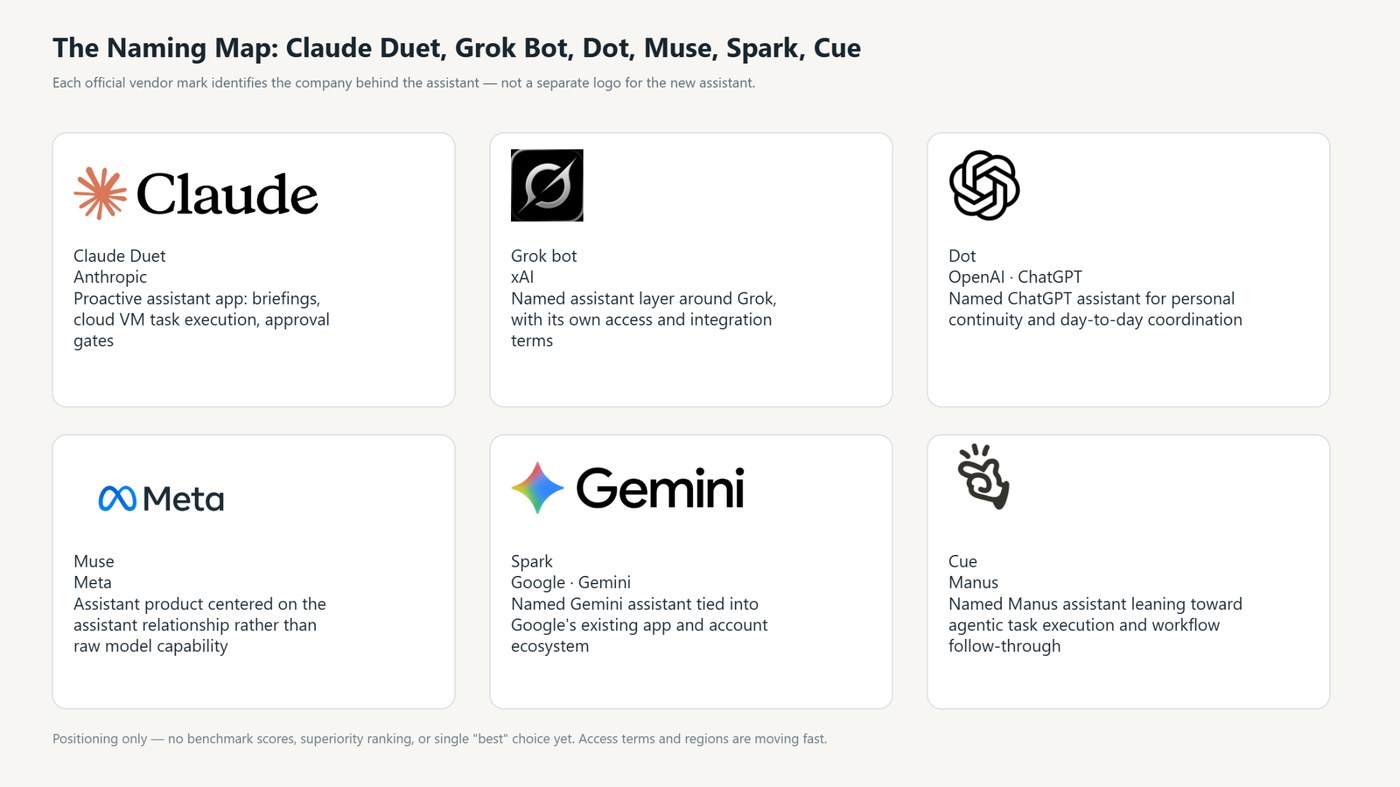
As of now, here is how the names line up. Access terms, regions, and feature sets are moving quickly, so treat this as a map of current positioning rather than a permanent catalog:
| Assistant | Vendor | Reported positioning |
|---|---|---|
| Claude Duet | Anthropic | Proactive assistant app on Claude Opus 5.5; morning briefings, cloud VM task execution, approval gates for sensitive actions; initial access reportedly limited to US Pro and Max users on a waitlist, labeled a research preview |
| Grok bot | xAI | Named assistant layer around Grok; similar proactive framing in demos, with its own access and integration terms |
| Dot | OpenAI (ChatGPT) | Named ChatGPT assistant focused on personal continuity and day-to-day coordination |
| Muse | Meta | Named assistant product; positioning centers on the assistant relationship rather than raw model capability |
| Spark | Google (Gemini) | Named Gemini assistant; ties into Google's existing app and account ecosystem |
| Cue | Manus | Named Manus assistant; leans toward agentic task execution and workflow follow-through |
Notice what the table does not show: benchmark scores, superiority rankings, or a single "best" choice. Those comparisons do not exist in a stable form yet, because the assistants differ more in access, integration, and permission model than in raw language ability.
A Worked Morning: How a Proactive Assistant Actually Behaves
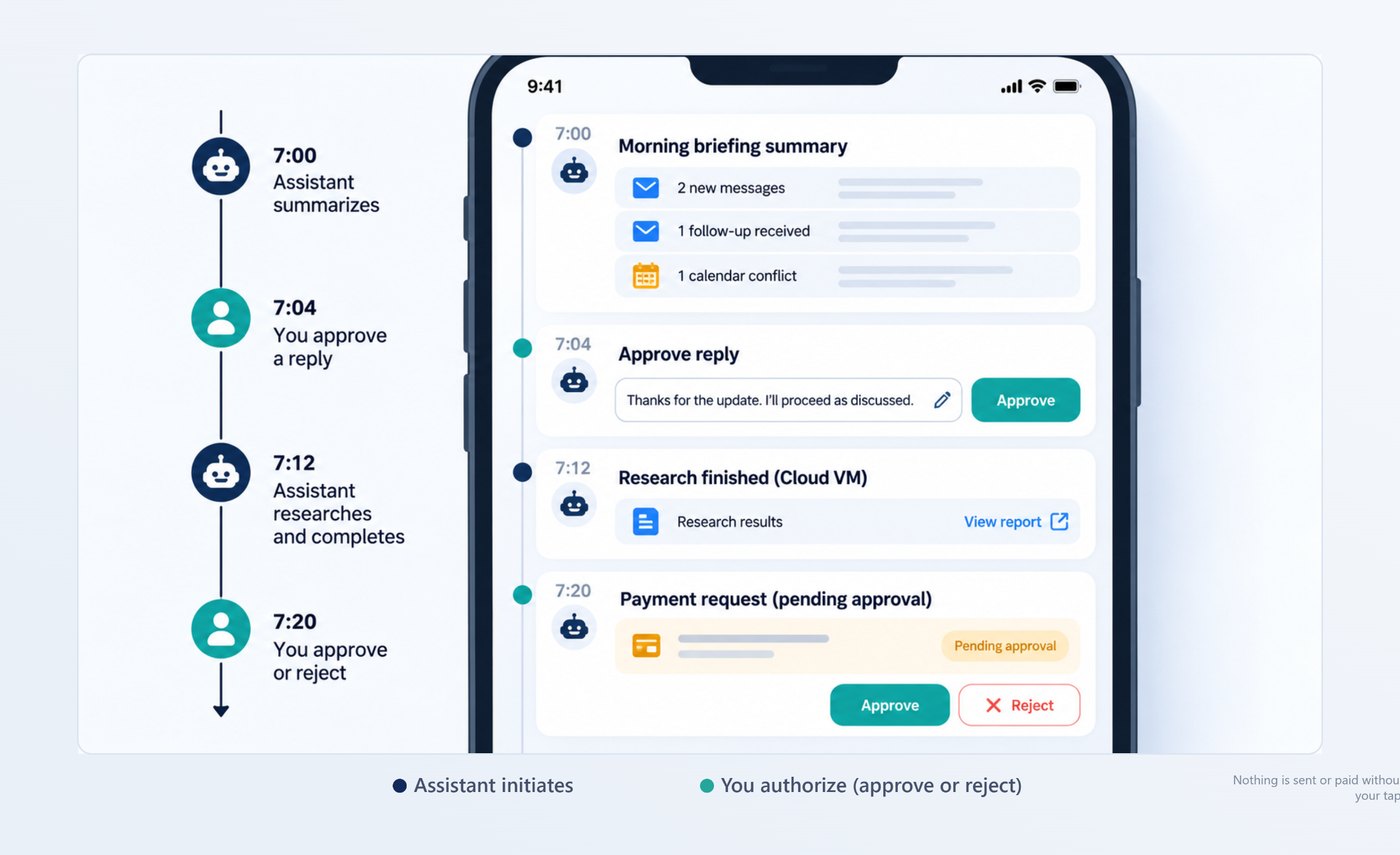
Abstract descriptions make these products sound interchangeable. A concrete timeline makes the differences visible. Here is a plausible morning with Claude Duet, following the behavior described in its positioning:
7:00 AM — Briefing arrives. You open the app and see a summary: two messages that need replies, one calendar conflict tomorrow, one task from yesterday still running in the cloud VM. You did not ask for any of this.
7:04 AM — You approve a reply. The assistant drafted a response to a scheduling message. You read it, edit one line, and approve sending. Sending is a gated action; without your tap, nothing goes out.
7:12 AM — Background work reports in. The research task that started the night before finishes in the virtual machine. You get a summary and a link to the results. The task did not depend on your phone staying unlocked.
7:20 AM — A payment request is blocked pending approval. The assistant prepared a payment action but cannot execute it without your explicit authorization. You reject it. This is the approval gate doing its job.
The pattern across every step: the assistant initiates, you authorize. If a product demo makes it look like the assistant simply acts, the demo is skipping the most important part of the workflow.
Where the Limits Sit
Three boundaries are worth checking before you evaluate any of these assistants:
Research preview status. Claude Duet is described as a research preview, which typically means features can change, break, or disappear without the stability guarantees of a mature product. Do not build a critical workflow on it yet.
Waitlist and regional access. Initial Claude Duet access is reportedly limited to Pro and Max users in the United States, with a queue to request entry. If you are outside that group or on a lower tier, the feature set you read about may not apply to your account at all.
Approval requirements by design. Messages, payments, signatures, and deletions require your approval. This is not a temporary limitation to be worked around; it is the safety model. If a workflow depends on fully autonomous execution of consequential actions, a proactive assistant in its current form will not deliver it.
Cloud execution and data location. Background tasks run in cloud virtual machines. That is what enables long-running work, but it also means your task data is being processed on remote infrastructure. The relevant questions are: which data is sent, where it is stored, and how long it is retained.
Why Claude Duet and Grok Bot Look Alike — But Are Not Interchangeable
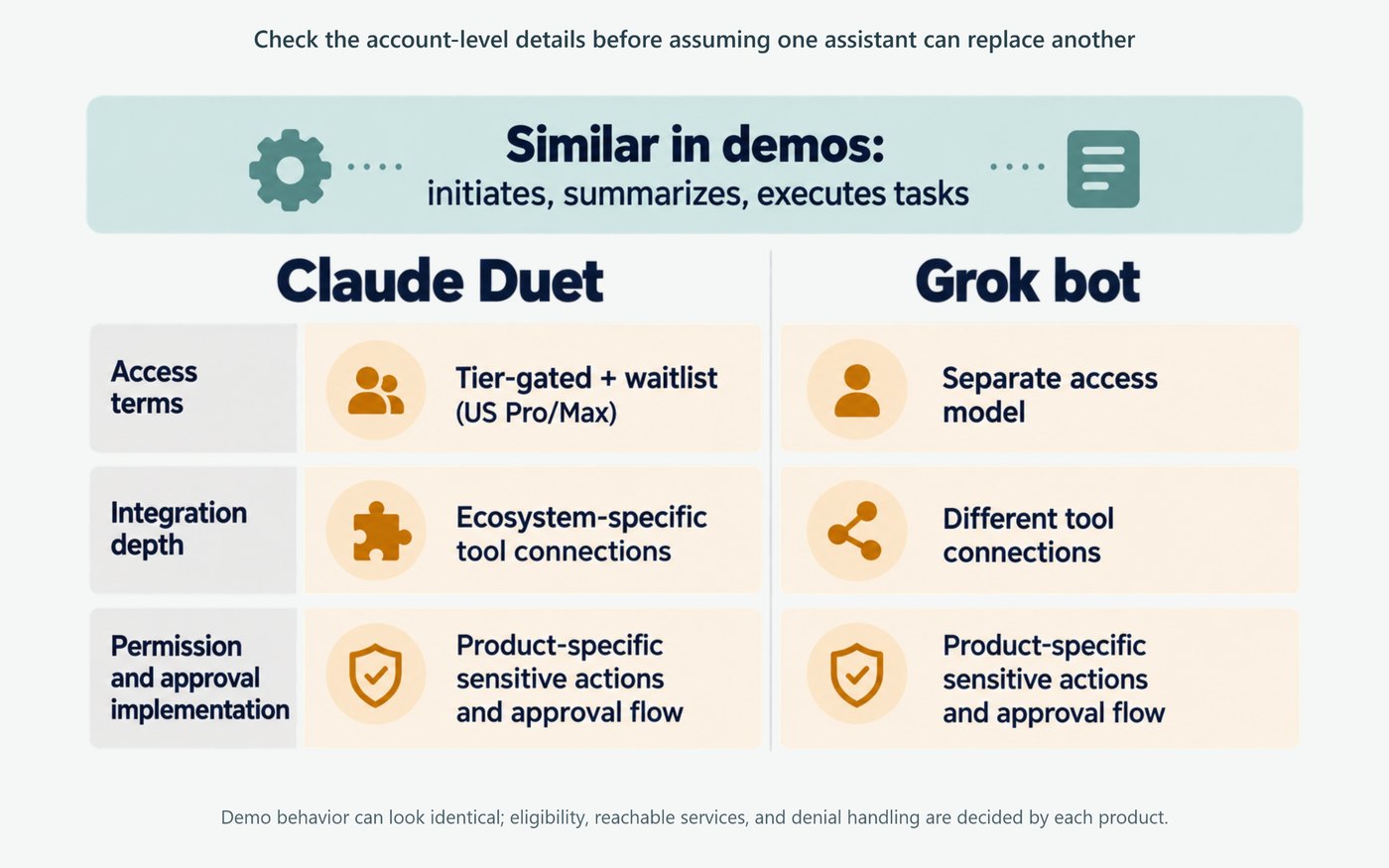
Side-by-side demos of Claude Duet and Grok bot can feel disappointingly similar: both show a named assistant that initiates, summarizes, and executes tasks. The material you have seen may leave you wondering whether there is any real difference.
The similarity is mostly at the interaction layer. The differences sit in three places that demos rarely show:
- Access terms. Claude Duet is gated to specific subscription tiers and a waitlist in a specific region. Grok bot has its own access model. Eligibility for one does not imply eligibility for the other.
- Integration depth. An assistant embedded in Anthropic's ecosystem will connect to different tools than one embedded in xAI's. The useful question is not "which is smarter" but "which one can reach the accounts and services you actually use."
- Permission and approval implementation. Even if both use approval gates, what counts as a sensitive action, how granular the permissions are, and what happens when you deny a request will differ by product.
Judging them by the demo is like judging two email clients by their splash screens. The real comparison happens in your own account, with your own integrations, over a week of ordinary use.
Common Misconceptions Worth Clearing Up
"A named bot is a new model." It usually is not. Claude Duet is reportedly built on Claude Opus 5.5. The name refers to the assistant product layer — briefing, memory, permissions — not a new foundation model.
"Proactive means autonomous." It does not. Proactive means the assistant initiates. Consequential actions still route through your approval. If a product ships without those gates, that is a reason for more caution, not more trust.
"Different names mean wildly different capabilities." Also no. Dot, Muse, Spark, and Cue may differ significantly in integration and access while performing similarly on everyday language tasks. The differentiation is in what they can reach and what they are allowed to do, not in how eloquently they summarize.
"Waitlist means the product is ready." A research preview behind a waitlist means the opposite: the product is being shaped with early users, and today's behavior may not match next month's.
How to Choose One Assistant to Try
Do not try all six at once. Pick one and evaluate it against a concrete workflow. Use this sequence:
Step 1: Check eligibility first. Before anything else, confirm whether you are in the supported region, on the required subscription tier, and off the waitlist. For Claude Duet, that means US-based Pro or Max access. Eligibility questions are answered faster than feature questions.
Step 2: Pick one real recurring task. Choose something you already do weekly: a morning inbox triage, a research summary, a meeting-prep brief. Vague exploration produces vague results.
Step 3: Run it for one week. Use the assistant daily on that one task. Track three things: how often the briefing was actually useful, how many approval prompts you received, and how often you had to correct or redo the output.
Step 4: Audit the permissions you granted. List every account and service the assistant can access. Revoke anything the task does not require. An assistant only needs the permissions your chosen workflow demands.
Step 5: Test the approval gates deliberately. Trigger a sensitive action — a message send, a deletion — and see exactly what the confirmation flow looks like. If you cannot tell what is about to happen before you approve, that is a meaningful red flag.
Step 6: Decide by integration, not by benchmark. The right assistant is the one connected to the tools you already live in, with an approval model you understand. Raw model quality matters, but it is rarely the deciding factor in daily use.
The Practical Takeaway
Claude Duet is the clearest current example of a proactive assistant: a named product that briefs you, runs background work in a cloud VM, and asks before it acts. Grok bot, Dot, Muse, Spark, and Cue are competing for the same daily surface under different names and different access terms. The names will keep proliferating; the underlying pattern will not change much: briefing, background execution, approval gates.
Evaluate them on access, integration, and permission clarity. Pick one, run it on a single real workflow for a week, and let your own routine — not the demo — decide whether a proactive assistant earns a place in your morning.