
<!-- Editorial review note, 2026-09-30 UTC: Selected the Google Research row from AI 新闻 A:F collected 2026-09-30 08:03 UTC. Other eligible rows concern general agents, biology, government search, and housing/healthcare funding; none has as direct an image-generation fit. Primary intent: assess composition and attribute control claims for image-tool purchase decisions. Distinct from the local 2026-09-29 speed/cost draft. Live homepage, blog index, attempted image-category URL, methodology and privacy pages were inaccessible; curl also failed DNS. Full live duplication and category checks remain unresolved. Internal links reuse only destinations in the previous local draft; their availability and currency must be checked by the editor. No claims about current listings or internal page contents are made. Google blog date and linked paper date were verified independently; blog coverage is not a new-paper launch. Article contains proposed tests, not measured product outcomes. Cover is conceptual AI-generated artwork; inline SVG is an original evaluation aid, not a reproduction of the research architecture. -->
Diffusion Controller: What Better Prompt Control Means for AI Image Buyers
Better AI image prompt control matters when a generator produces an attractive picture but ignores your instructions. For example, a fictional adult character portrait may have the requested blue jacket yet put the character against the wrong background. My judgment: assess whether a tool preserves your requested composition before buying access. A research announcement alone cannot establish that a listed product will do this.
What the announcement establishes
Google Research's Diffusion Controller announcement, dated September 29, 2026, describes a lightweight network for steering image generation. Its reported experiments use Stable Diffusion v1.4 and HPS-v2 preference evaluation. These are the researchers' results, not an independent test of any NSFWAITool listing. The announcement does not establish adult-content capability or deployment in an adult image service.
The underlying Diffusion Controller paper was submitted on March 7, 2026. Its gray-box approach keeps the backbone frozen but needs exposed intermediate denoising outputs. A service exposing only a prompt field and a finished image has not thereby demonstrated compatibility. Ask its operator which model interfaces an implementation uses before accepting a claim that this can be attached to any generator.
Google highlights a 90% win rate for a fully unlocked variant against the baseline. That figure is a comparative research result, not a 90% guarantee that your requested image will be correct. Its video discussion concerns future work. Do not use either statement as proof of better adult video generation. Read the experiment context before repeating the headline number.
The buyer problem: correct details versus attractive output
Start with a requirement you can inspect. Use a non-explicit prompt such as “a fictional adult in a blue jacket, holding a ceramic cup, beside a window.” Decide in advance whether the cup must be visible in the right hand. A polished portrait with an empty hand fails that requirement, even if you prefer its lighting. This makes your decision depend on the job rather than a pleasing thumbnail.
Score visual quality separately. For the same portrait, inspect the hand and cup rim at full resolution; record obvious deformation independently of whether the cup appears. If you combine those judgments into one “good image” score, a beautiful failure can hide weak prompt following. Two separate columns reveal whether stronger control helps the requested detail while damaging the drawing around it.
Keep identity consistency outside this first judgment. A correct cup does not prove that a generator can maintain the same character across several images. If consistency matters, add a separate comparison using reference material you own and a feature the candidate actually documents. For example, compare the same fictional character in two permitted outfits, then mark continuity as a distinct requirement rather than assuming prompt accuracy covers it.
Ask what the product actually implements
For candidates found through NSFWAITool's AI tool directory, request a precise release note before treating “better control” as a buying reason. Ask whether the improvement applies to text-to-image generation or an editor. A feature that changes a generated background could be useful, but it does not demonstrate that initial generation follows a complex composition prompt more reliably.
Request evidence of the named implementation if a vendor advertises Diffusion Controller. A useful reply identifies the deployed model version and explains the available control setting. Save that reply with its date. If support offers only a marketing phrase, record the implementation as unconfirmed. You can still evaluate the app's output, but describe your finding as a product observation rather than an endorsement of its claimed research connection.
Check what you can change in the interface. If there is a guidance control, save its displayed values and tooltip before testing. If no such control exists, compare the default workflow without pretending you evaluated a hidden setting. The meaningful question is whether the accessible product meets your requirement; an undocumented backend adjustment gives a buyer no reproducible procedure.
Run a small composition check with safe inputs
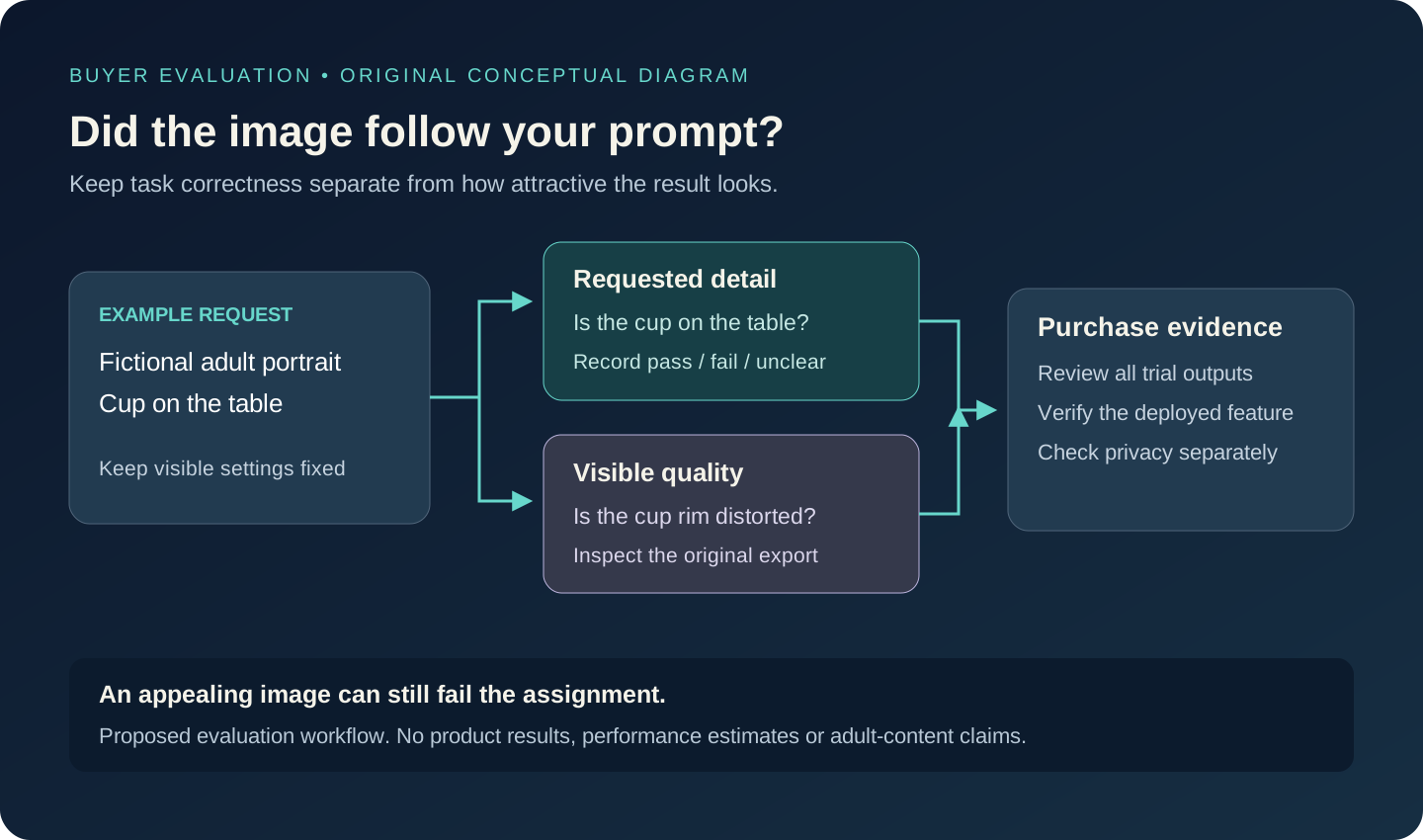
Write one base prompt and one controlled variation. For example, keep the fictional adult, jacket and window unchanged, but replace “cup in the right hand” with “cup on the table.” Generate both versions with the same resolution and model setting. If seeds are exposed, record them; if they are hidden, write “unavailable.” Never claim perfectly matched randomness when the interface cannot provide it.
Repeat each version four times as an initial screening exercise. Eight images can reveal an obvious repeated failure, but they cannot estimate general reliability across all prompts. Record each requested cup position as pass, fail or unclear. Do not choose the single best result for your comparison. Keep every output in order, including the empty-handed portraits that a promotional gallery might omit.
Use a second prompt only after recording the first. Try a fully clothed fictional adult standing beside a red chair, then change only the chair color to green. This tests a different attribute without adding more subjects or complicated action. If the tool gets the hand placement wrong but changes chair color correctly, describe those specific results. Avoid reducing different failure modes to “bad at prompts.”
Review the original exports instead of browser thumbnails. Open each file at its intended display size and inspect the requested object. A thumbnail may conceal a cup merging into a sleeve. Save the exact prompt beside the output filename, such as cup-right-01, so an editor can trace your judgment. This procedure is a proposed test; no product was tested for this article.
Interpret a preference score with care
The paper's full methods distinguish white-box access, which permits backbone changes, from gray-box access through limited interfaces. They also formulate a trade-off between steering toward a target and remaining close to the pretrained process. A frozen-backbone result and a jointly trained result therefore describe different configurations. Ask which configuration supports a product claim before comparing it with your own notes.
For your purchase, use a binary requirement alongside a quality note rather than treating an aesthetic preference as task success. Suppose two sample portraits both look appealing, but only one puts the cup on the table. You can prefer the other portrait's colors while still rejecting it for the assignment. This example explains why an overall preference headline cannot replace inspecting the particular detail you requested.
Confirm content rules and privacy independently
Open the candidate's acceptable-use rules before submitting a prompt. If the permitted content is unclear, ask support about your intended lawful use without uploading sensitive media. Do not infer adult-content support from the words “Stable Diffusion” or from an improvement to composition. Permission to use a feature and the ability to follow a prompt are separate questions that require separate evidence.
Use synthetic, non-explicit material for the first trial, and inspect upload retention before trying reference images. Consult the locally known NSFWAITool privacy checklist for adult AI tools when reviewing deletion and visibility. If a service says “private” without explaining retention, record that gap. A successful chair-color change supplies no evidence about where an uploaded file is stored.
Before committing money, locate the documented feature restrictions and review the candidate against NSFWAITool's review methodology. For example, confirm that the plan you are considering includes the control shown in its demo. Save a dated screenshot of that statement. Choose based on accessible functionality and your recorded composition results, rather than paying for an unverified research label.
FAQ
Is Diffusion Controller an NSFW image generator?
The September 29 announcement does not establish it as an adult image product. Before choosing a service, read that service's permitted-content rules and confirm the relevant feature exists. For example, a general image-control claim provides no evidence that a product accepts your intended lawful adult workflow or supports private uploads.
Can I install it in any closed image service?
Do not assume compatibility from a closed service's prompt box. The paper's gray-box method requires intermediate denoising outputs. Ask the operator whether those interfaces are available and whether it has deployed the controller. If you receive only finished images, evaluate the product as supplied rather than assuming you can attach this research implementation.
Does the reported 90% win rate mean 90% accuracy?
No. The announcement's figure compares a research variant with a baseline; it does not guarantee your requested details. Write a concrete pass condition, such as a cup resting on a table, and inspect each output against it. Record visual appeal separately so a pleasing picture cannot count as a correct composition by default.
What should I compare if a tool hides its seed?
Keep the prompt and visible settings fixed, repeat both prompt versions, and record that seeds were unavailable. For example, compare several right-hand cup requests with several table-cup requests. Report the observed counts as a small screening exercise. Do not describe the comparison as fully controlled or use it to promise general accuracy.
Should I buy a subscription because a vendor cites this research?
Request a dated release note and verify that your intended plan includes the claimed feature. Then run the non-explicit composition check before committing. If the vendor cannot identify its implementation, keep that claim unconfirmed. A subscription decision should rest on documented access and usable results for your task, rather than the research name.