
You are scrolling through social media at work when a friend sends a mysterious link with a laughing emoji. You tap it without thinking—and suddenly your phone plays something very much not designed for an open office.
That is the exact kind of awkward moment internet users have tried to prevent for decades. Long before platforms introduced content filters and blur screens, online communities developed their own warning signs: short labels that tell you what may be behind a link before you click.
The best-known example is NSFW. Alongside it, you may also see labels such as SFW, NSFL, hentai, and ecchi. These terms are not interchangeable, and they do not automatically tell you whether something is illegal. They are better understood as cultural shorthand: fast, imperfect signals about context, consent, and what may be inappropriate to view around other people.
What does NSFW mean?
NSFW stands for “Not Safe for Work.” It is used to warn that a link, image, video, or post may be inappropriate to open in a workplace, classroom, public space, or around family.
The label most often appears on sexual content, nudity, profanity, or suggestive material. But NSFW is broader than pornography. A post can be marked NSFW because it contains disturbing imagery, graphic language, offensive jokes, or anything likely to make the person next to you ask an uncomfortable question.
In other words, NSFW is not a legal classification or a moral verdict. It is a context warning.
A useful way to think about it is this: NSFW does not mean “forbidden.” It means “consider where you are before opening this.”
The term emerged from early online communities and became common across forums, email lists, and social platforms in the 2000s. Its longevity comes from its usefulness: four letters can prevent a surprisingly large amount of embarrassment.
SFW vs. NSFW: What is the difference?
The opposite label is SFW, short for “Safe for Work.”
SFW content is generally suitable for viewing in public or professional settings. That does not necessarily mean it is boring or completely family-oriented; it simply means it is unlikely to contain explicit sexual material, graphic violence, or highly offensive content.
- SFW: Suitable for most workplaces, classrooms, and public settings.
- NSFW: May contain sexual, explicit, disturbing, or otherwise inappropriate material.
- NSFL: May contain extremely graphic or psychologically disturbing material.
Not every platform applies these labels consistently. A creator's idea of “mildly suggestive” may not match yours, so it is still wise to use your own judgment.
What does NSFL mean?
NSFL usually means “Not Safe for Life.” It is an informal warning for content that goes beyond ordinary workplace awkwardness.
Posts tagged NSFL may include graphic violence, severe injuries, death, cruelty, or deeply disturbing material. The phrase is deliberately exaggerated, but its message is clear: this is not simply something you should avoid opening at work. It may be genuinely upsetting.
If NSFW is a yellow light, NSFL is a red one.
When you see this label, take it seriously—especially if you are sensitive to graphic imagery, are browsing late at night, or are already stressed or anxious. Curiosity is normal, but some images are hard to forget.
What does “hentai” mean?
In English-language internet culture, hentai usually refers to sexually explicit anime, manga, or anime-inspired artwork.
However, the word has a more complicated history in Japanese. The characters 変態 (hentai) can refer broadly to something unusual, abnormal, transformed, or perverse depending on context. Historically, the term also appeared in scientific and psychological writing. Over time, it became associated with sexual “deviance” in certain Japanese contexts.
When Japanese media and fan culture reached English-speaking audiences, Western fans adopted hentai as a category label for explicit animated or illustrated content. That meaning became widespread online—but it is not a perfect reflection of how the word is used in Japan today.
In Japan, adult manga and animation are often labeled with terms such as 18-kin (“18 prohibited,” meaning adults only) or other industry-specific labels. Calling an entire genre “hentai” is much more common in English-speaking fandom than in everyday Japanese usage.
That difference matters because internet slang often travels farther and changes faster than the culture it originally came from. If you are looking for the way current tools use the term, our AI hentai directory separates site labels from what each product actually offers.
Hentai, ecchi, and eroge: Commonly confused terms
Hentai
In English, this usually means explicitly sexual anime or manga. It is generally intended for adults.
Ecchi
Ecchi is often used for suggestive, flirtatious, or fan-service-heavy content that is less explicit than hentai. Think innuendo, revealing outfits, or comedic sexual situations rather than overt adult material.
The word is linked to the letter “H,” which became a Japanese shorthand associated with sexual or “naughty” behavior.
Eroge
Eroge is short for erotic game. It typically refers to adult-oriented video games, including some visual novels. Not all games with romance or fan service are eroge; the label usually implies sexual content intended for mature audiences.
These categories can overlap, but they are not identical. More importantly, labels can vary from one community or platform to another.
Why are tentacles and censorship so closely linked in internet culture?
One of the more recognizable—and often misunderstood—associations in adult anime culture is tentacle imagery.
This association is partly connected to Japan's long-running obscenity laws and media regulations. Article 175 of Japan's Penal Code concerns the public distribution, sale, or display of obscene materials, and adult publishers have historically used visual censorship, including mosaics, to comply with legal and industry standards.
Creators working within restrictions often develop alternative visual languages. In fantasy, horror, and science-fiction settings, nonhuman creatures, surreal imagery, and symbolic visual devices can become ways to imply what cannot be shown directly.
That does not mean every unusual trope exists because of censorship, nor does it reduce an entire creative tradition to one legal rule. But it is a useful example of how regulation, technology, and artistic expression can shape one another.
Why content labels matter more than ever
Today, content warnings are no longer just internet etiquette. They are part of digital safety.
AI-generated images and videos, misleading thumbnails, and deepfakes have made it harder to know what is behind a link. Scammers also use sexual or shocking content as bait because curiosity can override caution.
A post labeled NSFW may be harmless adult humor. But an unexpected link can also lead to malware, phishing pages, fake downloads, account theft, or extortion scams.
That is why the safest habit is simple: treat unexpected sensitive-content links with the same caution you would use for suspicious financial messages.
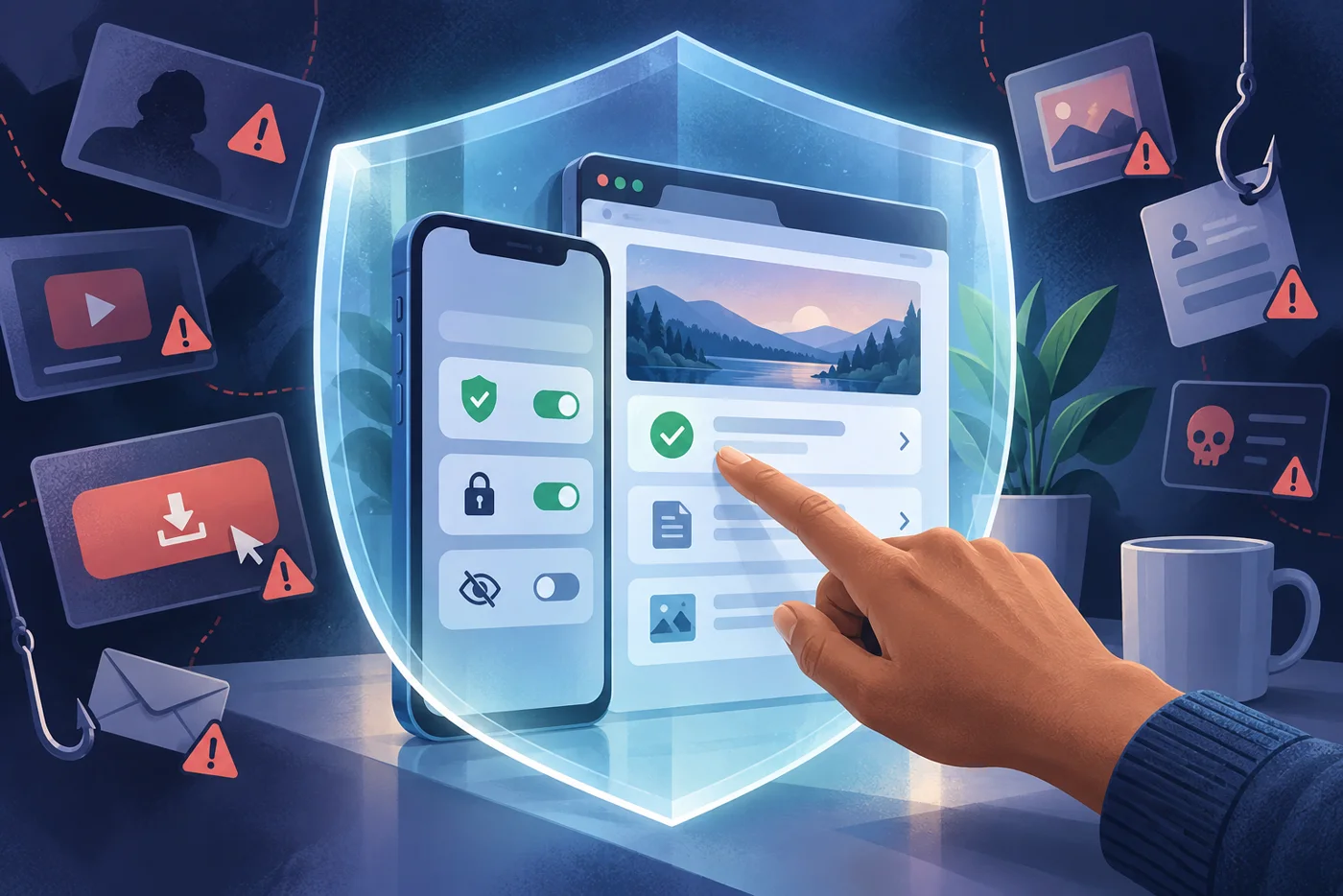
Practical tips for safer browsing
You do not need to avoid the internet entirely to avoid unpleasant surprises. A few habits go a long way:
- Do not open unexpected links from unfamiliar accounts, even if the message looks entertaining.
- Be cautious with “exclusive video,” “private photos,” or “download now” prompts.
- Keep your browser, phone, and security software updated.
- Use platform content filters and SafeSearch when browsing in public or around children.
- Never enter passwords or payment details after following a suspicious link.
- If someone threatens to expose private images or messages, do not pay immediately. Save evidence, block the account, report it to the platform, and contact local cybercrime authorities if necessary.
- Remember that a content warning is not a safety guarantee. It describes content—not the trustworthiness of the website hosting it.
These habits match the basic anti-phishing advice published by the U.S. Cybersecurity and Infrastructure Security Agency: do not trust an unexpected link merely because the message around it looks convincing.
Adult sites also ask for unusually sensitive data: face photos, private prompts, payment details, and sometimes voice or video files. Before uploading any of that, use our privacy checklist for adult AI tools to check retention, deletion, training use, and account controls. Our consent and safety standard explains the boundary around real people's images and non-consensual content.
The bigger story behind internet slang
Terms like NSFW and hentai show how language evolves online. A workplace warning becomes a universal social signal. A Japanese word takes on a specialized meaning in English-speaking fandom. A censorship practice becomes an instantly recognizable visual convention.
These labels may look like casual internet shorthand, but they do real work. They help people set boundaries, avoid unwanted content, and make better decisions before clicking.
The next time you see NSFW, SFW, NSFL, or hentai in a title or hashtag, you will know what the label is trying to tell you. And in the fast-moving, occasionally chaotic world of the internet, a little warning can be the difference between a harmless scroll and a very awkward Monday morning.
Frequently asked questions
Is NSFW content illegal?
No. NSFW simply means “Not Safe for Work.” It is a content warning, not a statement about legality. Laws vary by country, and illegal content should always be reported to the relevant platform or authorities.
Does NSFW always mean pornography?
No. NSFW can refer to nudity or sexual content, but it may also warn about graphic violence, offensive language, disturbing imagery, or other material unsuitable for public viewing.
What is the difference between hentai and ecchi?
In English-language usage, hentai generally refers to explicit adult anime or manga. Ecchi usually refers to suggestive or fan-service-oriented content that is less explicit.
What should I do if I accidentally open an NSFW scam link?
Close the page, do not download anything, and do not enter personal information. Run a security scan, change your password if you entered it, and enable multifactor authentication on important accounts.