Contents
- What did James Fishback actually propose?
- Was the 50% OnlyFans tax passed?
- What would 50% mean in simple terms?
- Why Florida’s tax structure made the proposal unusually complicated
- Why the headline spread so quickly
- What could a state-specific creator tax mean for the creator economy?
- What creators should watch for next
- The bottom line The OnlyFans sin tax was a January 2026 campaign proposal from then-Florida Republican gubernatorial candidate James Fishback—not an enacted law. Fishback proposed a 50% state charge on income earned by Florida OnlyFans creators, but the proposal itself did not create a tax obligation. Based on the available reporting and Florida’s election records, creators do not currently owe this special 50% charge.
Fishback later lost the Republican primary on August 18, 2026. The Florida Division of Elections candidate listing records him as defeated and eliminated rather than as the party’s nominee. That changes the political context, but it does not turn the proposal into law or resolve the policy questions it raised.
What did James Fishback actually propose?
In January, Fishback described a first-of-its-kind “OnlyFans Sin Tax” aimed at income associated with Florida creators on the platform. He presented it as both a deterrent and a source of funding for public priorities.
The spending ideas reported by ClickOrlando included public education, higher teacher pay, improved school lunches, crisis-pregnancy centers and a men’s mental-health post or official.
The “sin tax” label made the proposal easy to understand and easy to dispute. Sin taxes usually refer to targeted charges on products or activities that governments want to discourage, such as alcohol or tobacco. Fishback applied that framing to adult-content creation on a recognizable subscription platform.
The label did not answer the practical questions. A campaign slogan is not a tax code. The proposal did not come with bill text defining the tax base, filing process, effective date, enforcement agency or treatment of expenses and platform fees.
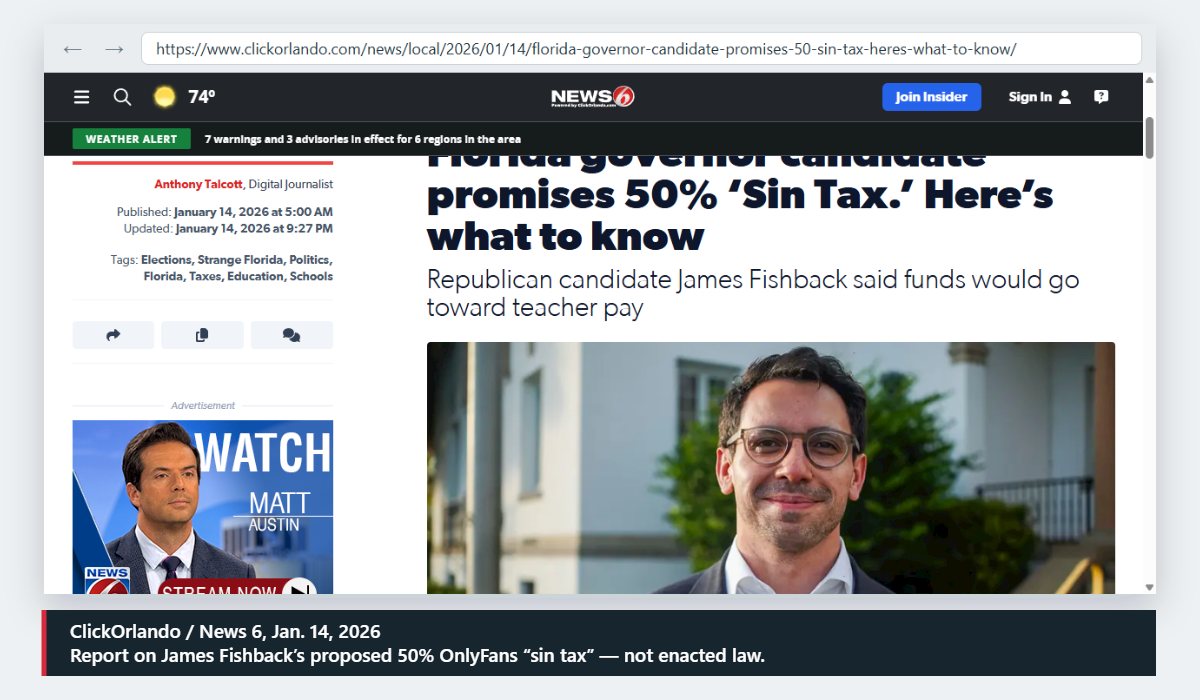
ClickOrlando / News 6, Jan. 14, 2026: reporting on James Fishback’s proposed 50% OnlyFans “sin tax,” not enacted law.
Was the 50% OnlyFans tax passed?
No. The reported measure was a campaign promise, not a law passed by the Florida Legislature. There is no supplied bill text, legislative vote, fiscal note, effective date or agency guidance establishing a current 50% OnlyFans tax.
A creator should therefore not read the viral headline as a new Florida filing requirement. A campaign proposal alone cannot tell a creator how much to pay, when to pay it or which income would be covered.
Fishback’s primary defeat also means current coverage should not describe him as Florida’s Republican nominee or imply that his proposal is moving through his campaign. The election result changes the political context; it does not create an alternative tax structure or provide a legal ruling on the idea.
What would 50% mean in simple terms?
Consider a deliberately simple hypothetical:
- Covered creator income: $10,000
- Hypothetical charge at 50%: $5,000
- Amount remaining: $5,000
The calculation shows the size of the headline, but it does not predict anyone’s actual liability. It assumes that the entire $10,000 is the relevant tax base and that the rate applies directly to it.
A real rule would need to specify whether “income” means:
- Gross payments received from subscriptions, tips and paid messages
- Money remaining after OnlyFans or payment-processing fees
- Net profit after business expenses
- Florida-sourced income only
- Income earned while the creator is a Florida resident
- A different amount calculated by the platform or tax agency
Those distinctions could produce very different results. If a creator receives $10,000 from subscribers but pays platform fees, equipment costs, editing expenses, advertising costs or other business expenses, a tax on gross receipts would not work like a tax on net profit.
The proposal reporting did not establish which approach would apply. The $5,000 figure is useful for understanding the potential scale of a 50% charge, not for calculating a current payment.
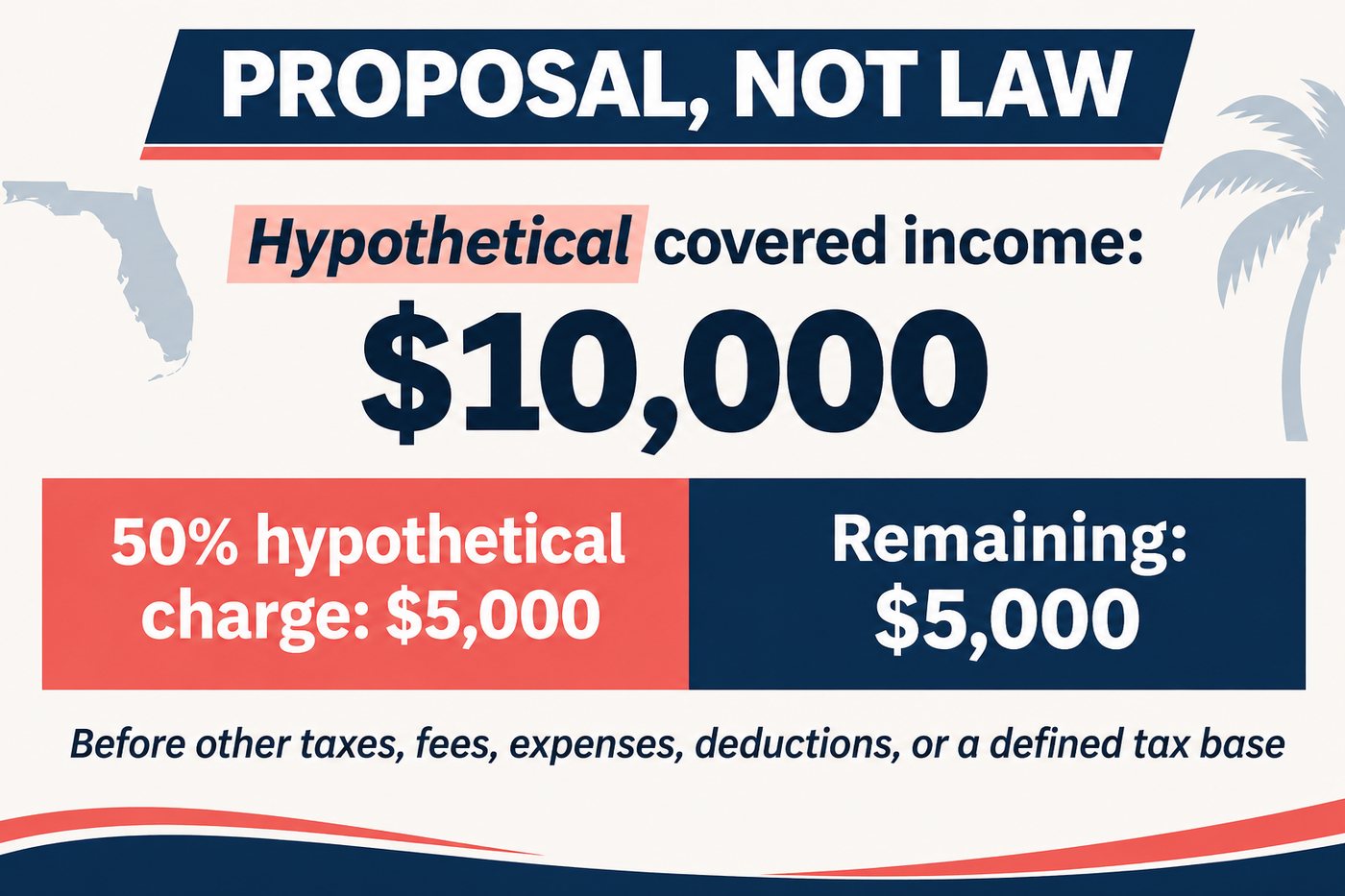
A simple hypothetical: applying 50% to $10,000 would produce a $5,000 charge and leave $5,000 before other costs or a defined tax base. The proposal was not enacted law.
Why Florida’s tax structure made the proposal unusually complicated
Florida’s constitution prohibits a state individual income tax. That creates a major design problem for a proposal described as a tax on creator income.
This does not mean that no possible charge could affect creator activity in Florida. It means policymakers would need to classify and structure the charge carefully. Calling something a “sin tax” does not bypass the constitutional question.
Several models could produce very different legal and economic effects.
An income tax
An income tax generally looks at money earned by an individual, often after considering deductions or expenses. A tax aimed directly at a creator’s personal income would raise the clearest conflict with Florida’s prohibition on a state individual income tax.
A gross-receipts tax
A gross-receipts tax could apply to money received by a business before ordinary expenses are deducted. That may be easier to describe as a business charge, but it could still create difficult questions about classification, exemptions and who counts as the taxpayer.
A transaction or platform tax
A transaction tax could attach to subscriptions, tips, paid messages or other payments processed through a platform. In that model, the charge might be collected at the payment stage rather than calculated from a creator’s annual profit.
Practical responsibility could shift toward the platform, payment processor or marketplace. The effects on subscribers, creators and platforms could also differ from those of an income-based rule.
An excise tax
An excise tax is usually imposed on a specific product, service or activity. A platform-specific charge could be described this way, but the label alone would not answer whether it was constitutional, how it would be collected or which services would be included.
No supplied material shows that Fishback formally selected one of these mechanisms. That left a substantial gap between the 50% slogan and an enforceable rule.
Why the headline spread so quickly
The proposal combined a familiar platform, an unusually large percentage, a moral argument and a direct response from a prominent creator.
Fishback presented the idea as both a deterrent and a source of funding for public priorities. Sophie Rain pushed back, arguing that creators already pay federal taxes and that many depend on platform income to support themselves or their families. CBS Miami’s report brought that creator-economy response into the wider debate.
The disagreement was not simply about a number. It concerned whether adult-content income should be treated as activity to discourage or as business income that should not face a platform-specific penalty.
The same tension appears in AI-platform moderation. NSFWAITool’s guide to why AI companies block NSFW content—and why filters overreach covers that adjacent platform-policy debate.
The two sides also focused on different levels of the tax system. Existing federal tax obligations are separate from a hypothetical Florida charge. Saying that creators pay federal taxes does not by itself resolve whether a state charge would be permitted. Likewise, saying that a new charge might fund schools does not establish that it could legally be collected.
What could a state-specific creator tax mean for the creator economy?
Even before enactment, a proposal like this can affect how creators and platforms think about location, product design and risk.
Relocation incentives
A large state-specific charge could encourage some creators to compare Florida with states that do not impose an equivalent burden. Relocation would not be a simple switch in an account setting, however. Residency, where work is performed, business entities, income sourcing and personal ties could all matter under an actual rule.
The proposal materials do not establish that creators moved—or would move—in response. The narrower point is that a high state-specific charge could influence future location decisions if it became enforceable.
Platform-neutral wording
Targeting OnlyFans by name is politically memorable, but it creates a policy-design question. If the underlying concern is adult subscription income, would the rule apply to every comparable platform? What about direct websites, paid messaging services, livestreaming platforms or new marketplaces that do not yet exist?
A platform-neutral rule would be broader and potentially harder to define. A platform-specific rule might be easier to communicate but could encourage businesses and creators to change platforms or payment arrangements.
Readers comparing different adult-platform ecosystems can use the NSFWAITool adult-platform directory as a separate discovery resource. That broader platform landscape matters because a rule aimed at one brand could influence where creators publish, collect payments or build audiences.
Collection and compliance
A future rule would also need to identify who handles collection. Would creators calculate and remit the charge themselves? Would the platform withhold it? Would payment processors report transactions? Would Florida require records from companies located elsewhere?
These questions affect administration as much as the rate does. A 50% charge that is difficult to define or collect could produce a different outcome from the campaign headline.
What creators should watch for next
If a similar proposal returns, look for concrete policy signals rather than relying on social posts or recycled headlines. The relevant documents and events would include:
- Bill text defining the taxpayer and the tax base.
- Legislative action, such as a filed bill, committee hearing or vote.
- A constitutional analysis addressing Florida’s prohibition on a state individual income tax.
- A stated effective date and transition rules.
- Agency guidance explaining registration, reporting and payment.
- Definitions of income, including subscriptions, tips, fees, expenses and refunds.
- Rules for residency and non-Florida platforms.
- Collection requirements for creators, platforms and payment processors.
Until those elements exist, the 50% figure should be treated as a campaign proposal and policy hypothetical—not as a current bill or creator liability.
The bottom line
The Florida OnlyFans sin tax was a viral January 2026 campaign idea from James Fishback: a proposed 50% charge on income associated with Florida OnlyFans creators. It was not enacted law, and based on the supplied reporting, Florida creators do not currently owe that special charge.
The proposal highlighted a difficult intersection of adult-platform policy, state taxation and creator economics. A real measure would have to address Florida’s constitutional restriction on individual income taxes while defining the tax base, collection method, platform coverage and residency rules. Until those details appear in actual legislation and official guidance, the correct reading is straightforward: 50% proposal, not 50% tax currently in force.