<!-- Editorial review: AI 新闻 A:F read live; selected row collected 2026-10-02 08:03 UTC. Spreadsheet title and specified parent folder confirmed through metadata. DOJ original opened and dated October 1; subpoena served September 30. Five eligible rows considered: DOJ cybersecurity inquiry gives a specific sensitive-chat buyer implication; Microsoft's voice announcement overlaps yesterday's voice intent; Claude Code mods, Clef classification and Shopify Canvas have weaker consumer fit. Primary intent: evaluating a companion operator's evidence about downstream chat data before sharing sensitive inputs, not voice licensing or a product review. NSFWAITool homepage, blog index, attempted companion category, methodology and privacy guidance failed web access; direct homepage curl failed DNS. Internal URLs reuse local draft context; current destinations and live cannibalization cannot be verified and require editor review. No claims about current NSFWAITool page contents. Local drafts checked for overlap. Diagram is hypothetical, not an audited architecture. All suggested checks are unperformed. No breach finding, integration, adult capability, price or measured result asserted. Cover generated with the built-in image tool: abstract phone and data-route folder, no logos or explicit imagery. -->
OpenAI Subpoena: Check AI Companion Data Evidence
Before sharing sensitive chats with an AI companion, ask its operator to explain where your messages go and what deletion covers. California's October 1 OpenAI announcement makes cybersecurity a timely question, but it does not establish that a companion app exposed private conversations. For example, a service advertising a familiar model name still needs to explain its own handling of your chat history.
My judgment: postpone sensitive inputs when the operator cannot give a specific answer about data recipients. Start with an ordinary fictional exchange, such as planning a weekend walk, while checking documentation. This recommendation concerns your disclosure decision; it does not rank named tools or turn a government inquiry into evidence against an unrelated app.
What the California announcement actually establishes
The California DOJ's October 1 announcement about its OpenAI subpoena says Attorney General Rob Bonta served the subpoena the previous day as part of an ongoing investigation. It describes questions about cybersecurity incidents and risks involving the company and its models. Record September 30 as the action date if you cite the event; October 1 is the release date.
The release also refers to an investigation into the Hugging Face incident. It presents an inquiry rather than a completed determination of responsibility. Do not rewrite that statement as “OpenAI leaked adult chats,” or attach it to a companion app without evidence connecting that app to an incident. Those examples would add claims the announcement does not establish.
Keep the evidence narrow when assessing a purchase. If an app names OpenAI, ask which feature uses that provider and what information it sends. The announcement supplies no companion integration details and establishes no adult image or video capability. A model name on a checkout page therefore cannot answer either the privacy question or the permitted-content question.
Separate the app you buy from the services it uses
Start with the candidate's operator identity. Open its terms or privacy page and record the company named there, with the page date if available. For example, the brand on a character selection screen might differ from the entity named in the terms. Ask support to clarify that relationship before deciding which company should receive your privacy questions.
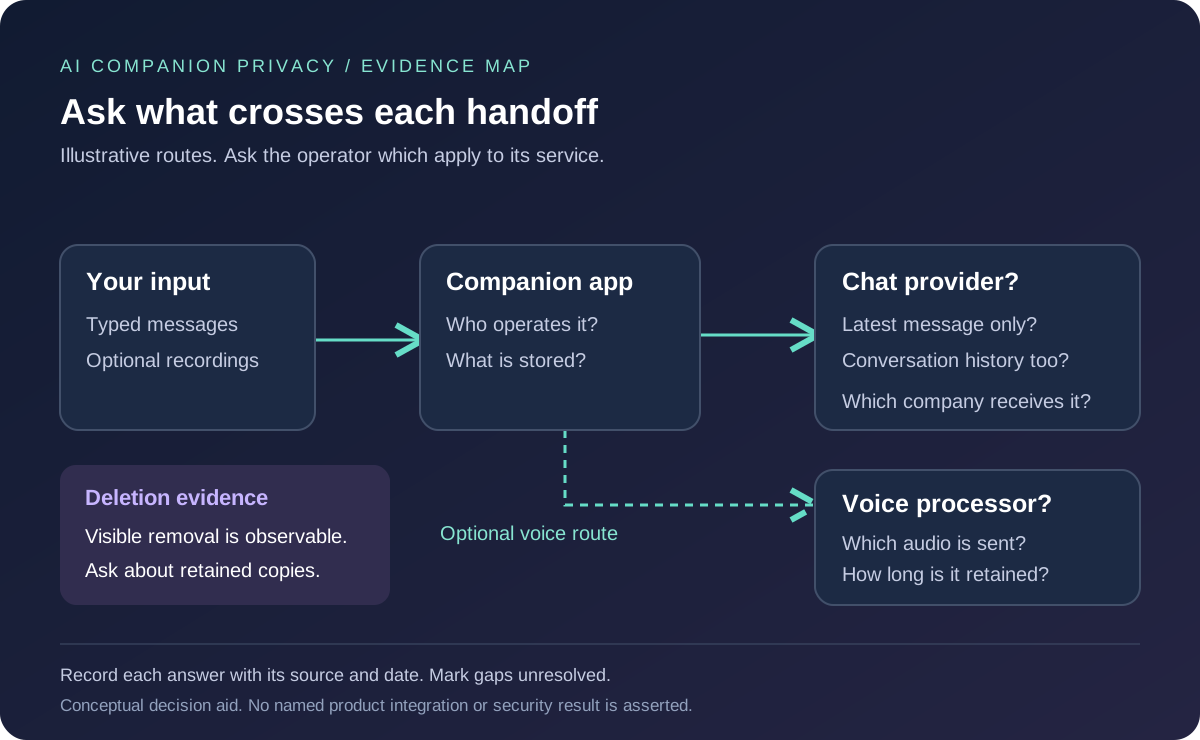
Use NSFWAITool's AI tool directory to organize candidates, then inspect each candidate's own documentation. Write down whether you plan to use text chat or an optional microphone feature. These modes raise different information questions: a typed reply does not by itself show whether a separate voice function sends recordings to another service.
Send one precise question: “For typed character chats, which external providers receive message content, and does that include stored conversation history?” Add a separate question for voice if you need it. Save the dated reply. An answer naming the text provider gives you a concrete lead; “we use advanced AI” leaves the recipient unidentified.
Build an evidence note instead of a privacy score
Make a local note with one row per question and a link to the supporting document. Label answers documented, support statement, observed interface, or unresolved. For example, seeing a private-profile toggle is an interface observation. It does not independently demonstrate that chat text stays within the operator's infrastructure or that stored messages are encrypted.
Record contradictions explicitly. If a help page says chats disappear immediately but support mentions retained records, quote the relevant short passages in your private note and ask which statement applies. Do not average the answers into a reassuring score. A conflict about retention needs a clarified scope, especially before you enter information that identifies you.
The following table offers questions, not ratings or findings about any listed product. Copy the rows you need and fill them with the candidate's answers. For instance, leave the recording row marked “not used” if you plan only to type; do not count an irrelevant feature as a missing privacy safeguard.
| Evidence question | Where to look | What an incomplete answer looks like | | --- | --- | --- | | Who receives typed messages? | Privacy notice and provider explanation | A model name without data scope | | Is conversation history sent too? | Feature documentation or support | An answer covering only the latest message | | What does deletion remove? | Delete dialog and retention explanation | Only a disappearing chat window | | Who receives optional recordings? | Voice documentation | A speech label without recipient details |
Read retention claims against specific data types
Use the locally known NSFWAITool privacy checklist for adult AI tools as a reference destination, then ask the operator about the data you actually create. For text chat, distinguish visible messages from saved character memory. For example, ask whether deleting a conversation also removes facts previously saved to a character's memory feature, if that feature exists.
Search the candidate's notice for “retention” and “training.” Record what each statement covers rather than treating one as an answer to the other. A hypothetical statement that messages are excluded from training does not specify their storage duration. Ask how long message content remains and whether the answer applies to the plan and feature you intend to use.
Ask about exceptions in plain language: “After I delete a chat, can message content remain in backups or security records, and for how long?” You are requesting scope, not assuming those copies exist. If the operator gives no duration, write “duration unresolved” in your note. Do not substitute a supplier's direct-user promise for an app-specific answer.
Check deletion with an ordinary fictional conversation
Create a harmless exchange such as “My fictional character likes rainy walks.” Avoid real names or personal contact details. Locate the delete control and read its confirmation text before using it. Save a screenshot locally if useful, taking care to exclude account identifiers. This gives you a concrete record of the interface claim without making a sensitive disclosure.
After deleting, reopen the conversation list and check any accessible saved-memory screen. Record what remains visible. If the character still repeats the fictional preference, ask whether that behavior comes from saved memory or another feature. A vanished chat verifies the visible change you observed; it cannot establish that every server-side copy was removed.
Check account deletion separately before buying a recurring plan. Find the documented procedure and determine whether it requires contacting support. You can inspect the procedure without deleting the account during this trial. For example, record the stated distinction between removing one conversation and closing the account, then ask what happens to retained chat content in each case.
Decide what information the evidence supports sharing
Use NSFWAITool's review methodology as a reference destination when preparing your notes for comparison. Keep the decision tied to your intended feature: text-only evidence cannot settle microphone handling. If one candidate documents text recipients while another leaves them unidentified, prefer the documented explanation for that question without claiming the first service has proven superior security.
When replies remain vague, continue with fictional, non-sensitive material or postpone the purchase. For example, an app that cannot explain whether it sends full conversation history leaves an unresolved disclosure decision even if its character dialogue feels convincing. The subpoena is the news trigger; your purchase judgment should rest on the operator's specific evidence and the limits of your own observations.
FAQ
Does the OpenAI subpoena prove an AI companion leaked chats?
No. The October 1 DOJ release describes an ongoing cybersecurity investigation, not a finding about a particular companion's chat history. Check whether the app actually identifies a relevant provider and request its data-handling explanation. A reference to OpenAI in marketing cannot establish either an integration or a breach.
What should I ask if a companion hides its model provider?
Ask which outside companies receive message content and whether they also receive conversation history. You can request that information without demanding private implementation details. For example, save a reply that identifies the chat processor separately from optional voice processing. If the operator gives no specific answer, record the recipient as unresolved.
Does deleting the visible conversation prove complete deletion?
No. Reopening an empty conversation list verifies an interface change, not every storage system behind it. Ask what deletion covers and whether any retained copies have a stated duration. Use a harmless fictional preference for your initial check, and inspect a saved-memory feature separately if the app provides one.
Is a no-training statement enough to protect sensitive chats?
Treat it as an answer about training only when its scope is clear. Ask separate questions about recipients and storage duration before sharing sensitive material. For example, a statement excluding messages from training does not tell you whether the app saves those messages for later conversations or how account deletion affects them.
Can I compare privacy without uploading personal information?
Yes. Read the candidate's documentation, request specific support answers, and try deletion with an ordinary fictional chat. For example, describe a character enjoying rainy walks instead of sharing a real address. These checks help compare available evidence while leaving security assurance unresolved; they are not an audit of the app's infrastructure.