
Introduction
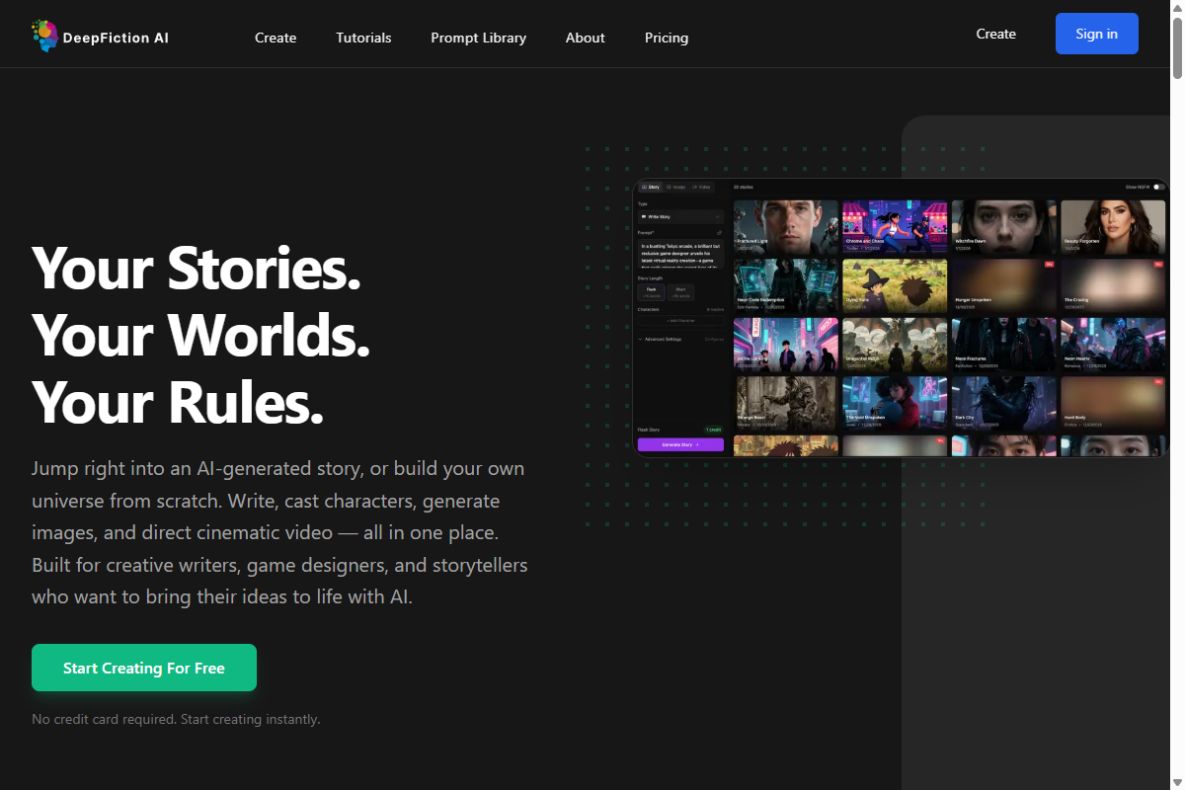
Most AI story sites make you choose between a writing tool and a character playground. DeepFiction tries to connect the whole chain. Write a story, save the cast, continue the narrative, visualize a character or scene, then turn a selected moment into a short video without rebuilding the idea in three unrelated services.
For a first story, Flash is the intelligent starting point: roughly 1,000 words for one credit. It is long enough to reveal whether the premise, voice and relationship work. Short aims closer to 5,000 words and costs three credits, so using it on an untested prompt can produce several pages of the wrong story. Find the chemistry in Flash, revise the premise, then expand.
The separate character fields matter more than they look. A name buried inside a large prompt gives the model almost nothing to preserve. Add appearance and personality for up to three important characters, especially the trait that creates friction. 'Confident' is decorative; 'uses jokes whenever she feels cornered' gives the dialogue something it can actually perform.
Persistent characters make the visual tools more than a novelty. Build the character once, reuse that identity across stories and generate matching art while the details are still fresh. The images and clips are useful for mood boards, covers, game pitches and private visual stories. They are not a substitute for a frame-by-frame video editor, and a generated character can still drift when clothing, age styling or camera angle changes sharply.
DeepFiction supports adult and mature creative work more naturally than a heavily filtered general assistant, but content freedom is not the same as good prose. The model will still reach for familiar phrases and rush an emotional turn if the prompt gives it only a list of explicit actions. Describe what each character wants before the scene, what changes during it and what must remain unresolved afterward.
Pricing begins low, with daily free credits and a Starter plan advertised at $5 per month before current introductory discounts. The unusual issue is ownership: paid subscribers retain full ownership of generated stories, while the terms give DeepFiction broader rights over work created on the free tier. Free is fine for testing. Move a manuscript you intend to publish onto a paid plan only after reading the current ownership language yourself.
Merits
- Stories, continuations, role-play, persistent characters, images and video clips live in one connected product.
- Flash and Short lengths make it possible to test a premise cheaply before committing to several thousand words.
- Reusable character profiles support more continuity than repeatedly describing the cast in a single prompt.
- Daily free credits and a low Starter price make the complete workflow accessible to casual creators.
Disadvantages
- Generated prose still needs revision for repetition, pacing and the emotional logic between explicit events.
- Image and video consistency can drift when a recurring character's angle, styling or environment changes substantially.
- Free-tier story ownership terms are less favorable than the full ownership offered to paid subscribers.
- Plan descriptions use broad volume language such as dozens or hundreds instead of a simple per-tool allowance table.
Key Features
Flash and Short stories
Generate roughly 1,000 words for one credit or about 5,000 words for three credits, then continue the parts worth developing.
Persistent custom characters
Define appearance, personality and backstory once, then cast the same character in new stories, role-play and visual scenes.
Story continuation
Extend an existing narrative without replacing the premise, useful for turning a successful test scene into a longer arc.
Matched images and editing
Generate character art and scene illustrations, edit or upscale selected visuals, and keep them close to the story workspace.
Cinematic video clips
Translate a chosen idea into a short visual sequence for mood, pitch material or a private illustrated narrative.
Editor Score
DeepFiction is scored as a multimodal narrative studio. It is more compelling when text, recurring characters and visuals belong to the same project; prose polish and free-tier rights still require attention.
| Criterion | Score |
|---|---|
| Story workflow and continuity | 18 / 20 |
| Character reusability | 18 / 20 |
| Image and video integration | 18 / 20 |
| Prose quality and steering | 15 / 20 |
| Pricing and ownership clarity | 14 / 20 |
| Total | 83 / 100 |
Rate Plans
Use free daily credits to test one Flash story and one character. Starter is the natural first paid plan; move higher only when image and video use, not just text, consistently exhausts the smaller allowance.
| Plan | Price | Who it suits |
|---|---|---|
| Free | $0 | Daily credits and access to core story, character, image and video features without a credit card. Free-tier ownership terms differ from paid plans. |
| Starter | $5/month list price | Designed for dozens of stories, images and other creations. The site may show a temporary first-month discount. |
| Pro Creator | $20/month list price | Built for hundreds of creations and more consistent daily work across stories, images, characters and video. |
| Studio | $75/month list price | High-volume capacity, priority access and performance for creators running many projects. |
The current pricing page advertises temporary first-month discounts of 20 percent and also offers annual billing and one-time packs. Confirm the renewal price and allowances at checkout. Paid subscribers retain full ownership of generated stories under the current terms; free accounts receive different rights.
Alternative Tools
| Tool | Why compare it |
|---|---|
| RedQuill | RedQuill is faster for a private adult fantasy built from community ideas and direct prompts. DeepFiction offers the wider path from prose into persistent characters, images and cinematic clips. |
| NSFWriting | NSFWriting exposes denser controls for scene lists, SillyTavern cards, previous summaries and very long drafts at a low price. DeepFiction has the friendlier multimodal workspace. |
| SudoWrite | Sudowrite is the more polished manuscript assistant for brainstorming, describing and revising serious fiction. DeepFiction is less text-specialized but includes adult-friendly visual creation in the same account. |
Frequently Asked Questions
Should I generate a Flash or Short story first?
Start with Flash. Its roughly 1,000 words are enough to judge voice and chemistry for one credit. Use Short after the premise has earned another 5,000 words.
Can I reuse the same character?
Yes. Custom characters can carry their personality, backstory and visual direction into different stories and creative modes.
Does DeepFiction create adult content?
The platform supports broad and mature creative storytelling, subject to its current terms and prohibited-content rules. Test the exact kind of legal adult fiction you write before subscribing.
Can it make images and video from a story?
Yes. Image generation, editing, upscaling and short cinematic video creation are part of the same broader studio, though visual identity can still drift between difficult scenes.
Who owns a generated story?
Paid subscribers retain full ownership, copyright and intellectual-property rights under the current terms. Free-user work is governed by broader platform rights, so read that section before publishing commercially.
Which plan is best for a first paid month?
Starter is enough for a genuine workflow test. Pro Creator makes sense only after frequent stories plus images or videos exceed the smaller plan's practical capacity.