
Introduction
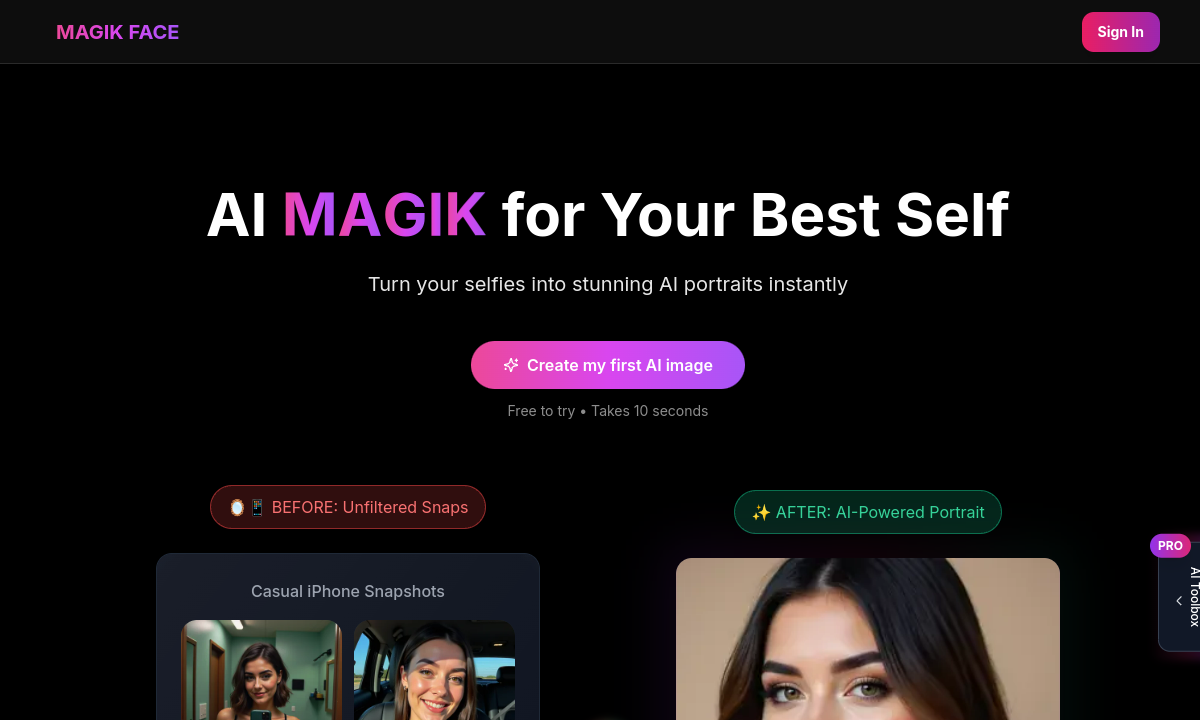
Most AI image generators create a new face every time you prompt. Magik Face takes the opposite approach: you feed it 10-20 photos of one person or character, and it trains a small custom model locked to that identity. From there, every portrait, style shift, and short animation draws from the same trained face. For creators building a virtual model portfolio, a fictional character bible, or a consistent set of stylized portraits, that train-once-apply-many workflow is the real product. You're not buying individual images—you're buying a reusable identity engine with pay-as-you-go credits instead of a monthly subscription.
The process unfolds in three stages. First, you prepare 10–20 clear reference photos. Keep the identity recognizable and avoid filling the set with heavily filtered or contradictory images; the custom model can only learn from what you give it. Second, Magik Face trains a personal model, advertising roughly two minutes for training and ten seconds for initial results. Treat those as service targets rather than guarantees. Third, you generate through a suite of tools—Playground for exploration, Photoshoot for structured portraits, Pose for position control, and Style for artistic direction.
Once your model is trained, the style options open up considerably. Magik Face lists over 100 styles spanning realistic, anime, fantasy, cyberpunk, watercolor, and more, plus LoRA support on paid bundles for finer stylistic control. Beyond stills, the platform includes HQ video generation, extending the same trained identity into animated content. There's also a Touch tool for refinement and Magik Craft for enhancement and export. The breadth is genuinely wide for a tool built around one trained identity, making it possible to produce everything from photorealistic portraits to stylized anime renders without switching platforms.
Magik Face makes the most sense for creators who need the same face across a catalog of outputs: virtual influencers, character designers, fantasy portrait makers or anyone tired of re-prompting for the same look. It's less useful if you want a single novelty portrait, a quick anonymous edit or a face pasted onto an existing video—other tools handle those jobs more directly. It is also not a chat companion or roleplay platform. The requirement to prepare 10–20 suitable photos up front means casual curiosity may disappear before the first polished output.
Rather than a subscription, Magik Face sells Ruby credit bundles as one-time purchases. The Try It tier costs $9.99 for 50 Rubies, positioned as a low-commitment test drive. Casual at $24.99 delivers 200 Rubies with full feature access including AI model training, HQ video generation, 100-plus styles, and LoRAs. Elite bumps to 500 Rubies for $49.99, and the Power Pack targets agencies at $300 for 5,000 Rubies. The per-Ruby price drops meaningfully at higher tiers, which rewards committed creators over casual experimenters.
The platform's deepfake policy is explicit: real-person content requires verifiable consent, and violations can trigger a ban—this isn't a tool for scraping social media photos and calling it art. Refunds are narrow, limited to double billing or technical failures, and requests must land within 14 days. The quality of your trained model depends heavily on the input set; inconsistent lighting, angles, and resolution mean inconsistent portraits downstream. And Magik Face isn't a chat companion or roleplay product—if that's what you need, other tools in this space serve that purpose better.
Merits
- Train-once workflow locks a custom model to one identity and reuses it across every portrait, style, and video—no re-prompting each time.
- Over 100 styles plus LoRA support cover realistic, anime, fantasy, cyberpunk, and watercolor looks from a single trained model.
- HQ video generation extends the same identity into animated content, adding a format most portrait-focused tools skip entirely.
- Pay-as-you-go Ruby bundles avoid monthly subscription commitments and let spending scale to actual production volume.
Disadvantages
- Ruby costs per training job, image, and video are not published, making it impossible to estimate how many outputs a bundle will actually produce.
- A good custom model requires 10-20 consistent, high-quality reference photos; poor input quality degrades identity lock significantly.
- Not a face swap or deepfake service—real-person content requires explicit consent and violations can result in a ban.
- Refund policy is narrow and time-limited, restricted to double billing, technical errors, or service failures within 14 days.
Key Features
Custom Model Training
Upload 10-20 photos to train a personalized model locked to one identity, then reuse it across all future outputs without re-training.
Style Library
Over 100 styles covering realistic, anime, fantasy, cyberpunk, watercolor, and more, with LoRA support on paid bundles for finer control.
HQ Video Generation
Create short animated videos from your trained model, extending the identity consistency from still portraits into motion content.
Generation Tools Suite
Playground, Photoshoot, Pose, Style, Touch, and Magik Craft each handle different stages from creative exploration through refinement to final export.
Privacy Controls
Uploaded images and trained models remain private to the account and are not shared with third parties for advertising purposes.
Pay-As-You-Go Credits
Ruby credit bundles replace monthly subscriptions, letting users buy only what they need and scale spending to match actual production volume.
Editor Score
Magik Face solves a specific creator problem well: train one identity, then reuse it across many portraits and animated scenes. Its style range and one-time Ruby bundles make the workflow flexible. The score stops short of excellent because the bundle table never converts Rubies into training, image or video costs, so buyers cannot estimate real output before entering the workspace.
| Criterion | Score |
|---|---|
| Custom Model Workflow | 18 / 20 |
| Style and Output Range | 17 / 20 |
| Pay-As-You-Go Flexibility | 17 / 20 |
| Identity Consistency | 16 / 20 |
| Credit Transparency | 12 / 20 |
| Total | 80 / 100 |
Rate Plans
Magik Face's pay-as-you-go model means no recurring charges, but it also means you buy credits without knowing exactly what they'll produce. Start with the free entry point to explore the interface and basic output quality. The $9.99 Try It bundle makes sense as a second step only after you've confirmed the live Ruby cost of model training and at least one output in the style you want. The $24.99 Casual bundle offers a meaningfully lower per-Ruby rate for users ready to commit, while the $49.99 Elite tier improves that rate for frequent creators. The $300 Power Pack should follow proven recurring production, not curiosity.
| Plan | Price | Who it suits |
|---|---|---|
| Try It | $9.99 one time | 50 Rubies; positioned as a quick test drive to explore the interface and a few outputs. |
| Casual | $24.99 one time | 200 Rubies; includes AI model training, HQ video generation, 100+ styles and LoRAs, with advertised two-minute training. |
| Elite | $49.99 one time | 500 Rubies with the same premium capabilities, aimed at frequent creators who need a better per-Ruby rate. |
| Power Pack | $300 one time | 5,000 Rubies for agencies and power users with established production workflows. |
Payments are generally non-refundable except in cases of double billing, technical error, or failure to provide the intended service. Eligible refund requests must be submitted within 14 days.
Alternative Tools
| Tool | Why compare it |
|---|---|
| PlayBox | PlayBox animates existing adult stills through motion templates. Magik Face starts earlier in the pipeline by training the face model first, then generating both stills and video from scratch—useful when you don't already have finished images to animate. |
| ZenCreator | Compare character quality, model control, memory, and total monthly cost with MagikFace. |
| PlayFlux | Compare character quality, model control, memory, and total monthly cost with MagikFace. |
Frequently Asked Questions
How many photos are needed to train a model?
The quick-start guide recommends 10-20 high-quality photos with varied angles, expressions, and ideally consistent lighting. The better your input set, the more reliable the trained model will be across different styles and poses.
Is Magik Face a face swap or deepfake tool?
No. Magik Face trains a custom model from your photo set and generates new images and videos—it does not paste faces onto existing media. Real-person content requires explicit consent per the terms of service, and deepfake generation can result in an account ban.
Does it make videos?
Yes. HQ video generation is included on paid Ruby bundles from the Casual tier upward. Video outputs draw from the same trained model as still portraits, keeping the identity consistent across both formats.
Is there a subscription?
No. Magik Face uses one-time Ruby credit bundles starting at $9.99 for 50 Rubies. There are no recurring charges unless you choose to purchase additional bundles.
Which Ruby bundle should a new user buy?
Start with the free entry point to explore the interface. If the workflow suits you, the $9.99 Try It bundle lets you test model training and a few outputs. The $24.99 Casual bundle offers a meaningfully better per-Ruby rate for users ready to produce at scale.
Can you calculate how many outputs a bundle will produce?
Not from the published pricing. Magik Face lists the Ruby totals for each bundle but does not disclose the Ruby cost per training job, image, or video on its pricing page, making it impossible to calculate outputs before buying.