
Introduction
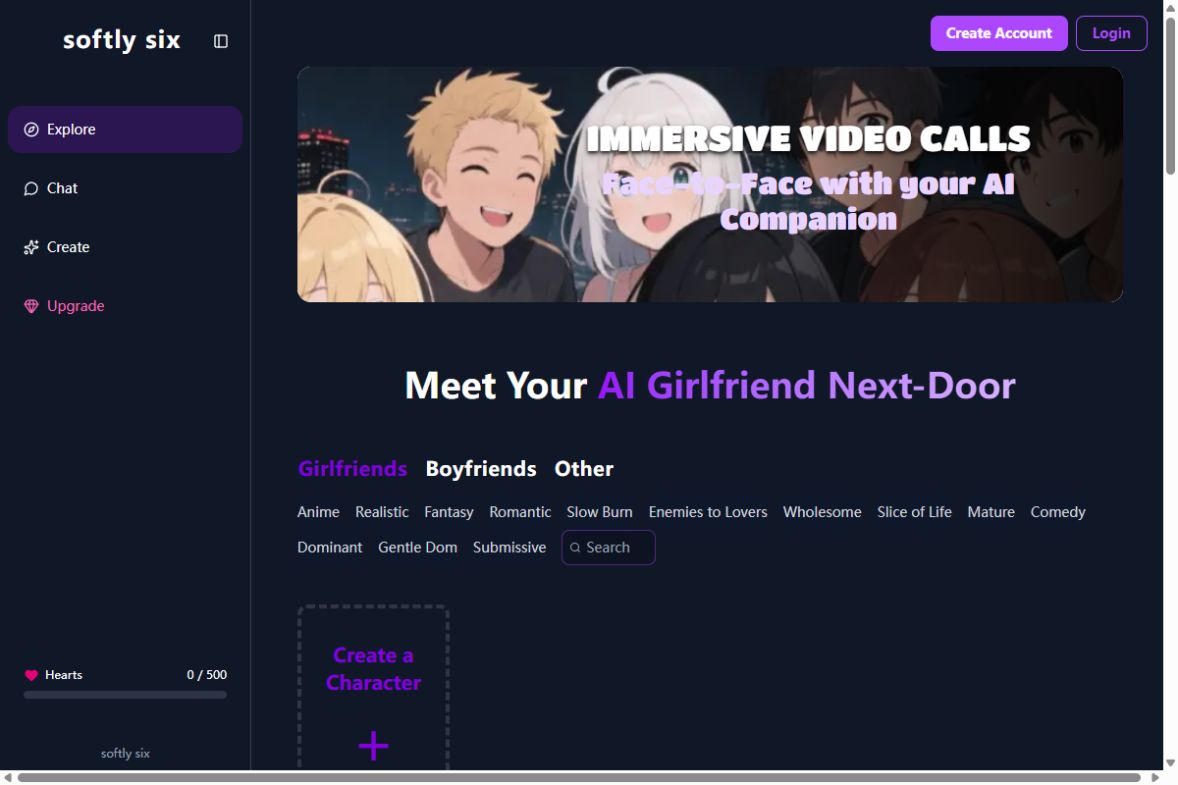
Most AI companion tools build outward from text. Chat is the core loop; voice, images or video are bolt-on extras you unlock or toggle. SoftlySix inverts that framing. Its homepage leads with video calls — companions you can see and hear, responding in real time — and only mentions text chat and image requests as parallel options. A video-first interface means the AI's face, voice and movement are the default experience, not a premium layer you activate after reading blocks of prose. For users who find text chat isolating, the pitch is direct: put the companion on screen and let conversation feel more like presence than narration.
Seeing a companion react on camera during a conversation changes the emotional texture of the exchange. A smile, a tilt, a shift in vocal tone carry meaning that words alone do not. SoftlySix centers video calls as the primary mode rather than a bonus feature. The result is a stronger sense of being in the room with someone rather than directing a character through a script. Whether that feeling holds depends on video quality and latency, neither of which the homepage or support pages detail.
Personality tuning is a core mechanic here, with dedicated guides for shaping how your companion speaks, behaves and responds. On a video call, personality differences affect pacing, facial expression, tone of voice and reaction speed — all things you perceive in real time. Getting the personality right carries more weight than on a text platform, where you can gloss over flat phrasing by skimming. SoftlySix puts the work on you to tune carefully, which rewards patience but requires investment upfront before the companion feels like your own.
The system bundles video calls, text chat and image generation into a single companion rather than separating them into distinct tools. You can move between calling and texting without switching platforms, and request generated images during a conversation to anchor a scene visually. For roleplay, a sudden image of a setting or outfit can deepen immersion beyond text description. Your companion's identity stays consistent across modalities. The tradeoff is that each mode adds complexity to setup, and the homepage does not show how much control you have over image style or video appearance.
Roleplay is one of SoftlySix's stated use cases, and the video call format offers something text-based roleplay cannot: visible, audible reaction from the AI in real time. Where text roleplay asks you to read and imagine, video roleplay shows you a face responding to what you say. That shifts the creative burden from imagination to sight and sound, which is more immersive when the companion performs well and more limiting when it does not. No independent reports on video quality or conversational fluidity appear in search results.
SoftlySix suits a specific buyer: someone who finds text chat emotionally insufficient and wants a companion they can see and hear during conversation. If that is your primary need and you are willing to invest time in personality tuning, the video-call-first model is worth testing through a free account. If your priority is a large library of pre-built characters, detailed written roleplay or granular control over backstory and writing style, you will find more of that on platforms like CrushOn AI or GirlfriendGPT.
Merits
- Video-call-first design distinguishes it from the vast majority of AI companion platforms, which default to text and add media later.
- Personality tuning is presented as a core mechanic with dedicated guides rather than a buried setting, giving you direct control over companion behavior.
- Bundling video calls, text chat and image requests into one companion identity keeps the experience coherent across different interaction modes.
- Use cases extend beyond adult chat to conversation practice, emotional support and general companionship.
Disadvantages
- No pricing is visible on the site. The pricing page, privacy policy, terms of service and refund policy all require account creation before showing any content.
- The homepage and support pages provide no information on video call quality, latency, resolution or how the companion appears on screen.
- No independent user feedback or community discussion exists for this product.
- Character discovery and pre-built companion options are not shown, so there is no indication of how many or what kinds of companions are available without creating an account.
Key Features
Video Call with AI Companion
The companion appears on screen and responds audibly in real time, shifting the interaction from reading text to watching and listening.
Text Chat
An alternative mode for when video is impractical or unnecessary, keeping the companion accessible outside a call context.
In-Conversation Image Requests
You can ask for generated images during a chat or call, anchoring a scene visually without switching to a separate image generation tool.
Personality Tuning Guides
Dedicated guides walk you through shaping how the companion speaks, behaves and reacts, making personality adjustment a first-class part of setup.
Companion Creation
You build your own companion rather than only choosing from a pre-existing catalog, giving you direct control over identity from the start.
Free Account Option
You can create an account at no cost and explore the interface before committing to a paid weekly plan referenced on the homepage.
Editor Score
SoftlySix makes a real architectural bet by centering video calls over text chat, and that bet is what makes it worth attention if presence matters to you. Companion creation and personality tuning give you genuine control, and the multi-modal bundle keeps things coherent. The lack of public pricing, no detail on video quality, and zero independent user feedback mean you are testing on faith.
| Criterion | Score |
|---|---|
| Video Call Immersion | 14 / 20 |
| Companion Customization Depth | 14 / 20 |
| Pricing Transparency | 6 / 20 |
| Multi-Modal Coherence | 15 / 20 |
| Independent Confidence | 8 / 20 |
| Total | 57 / 100 |
Rate Plans
SoftlySix references a weekly plan on its homepage with a 50% discount for your first week, but no actual price is published anywhere on the site. The pricing page, privacy policy, terms of service and refund policy all require account creation before displaying content. Create a free account first and inspect the pricing details, billing terms and refund conditions before entering any payment information. If you are comparison-shopping against tools with visible pricing like CrushOn AI or OurDream AI, this lack of transparency is a real disadvantage.
| Plan | Price | Who it suits |
|---|---|---|
| Weekly Plan | Shown after sign-in | The homepage states a weekly plan exists with 50% off the first week. Specific price, feature scope and usage limits are not published. |
All pricing, billing terms, refund conditions and policy details are gated behind account creation. The homepage references a weekly plan with a 50% first-week discount but does not state the base price, renewal terms or refund eligibility. Verify every billing detail before subscribing.
Alternative Tools
| Tool | Why compare it |
|---|---|
| CrushOn AI | CrushOn AI is built for text-based character roleplay with a large public library, model switching, group chat and detailed character cards that establish voice, conflict and motivation. If you want a deep roster of pre-built characters and granular written storytelling, CrushOn is the stronger choice. SoftlySix trades that breadth for video call presence — fewer characters on camera instead of many on screen as text. Pick CrushOn for variety and writing depth; pick SoftlySix if seeing and hearing the companion matters more than catalog size. |
| GirlfriendGPT | GirlfriendGPT offers a large browsable catalog of adult AI personas, custom character creation and uncensored private chat with optional images and voice. Its strength is discovery: you can scroll through characters by gender, style and scenario before committing to a conversation. SoftlySix skips catalog browsing and puts you directly into a video call with a companion you build yourself. Choose GirlfriendGPT if you want to explore many characters quickly; choose SoftlySix if you prefer to build one companion and interact through live video. |
| OurDream AI | OurDream AI combines text chat, generated images, voice interaction and short video clips around a single persistent companion, building outward from chat and adding media as separate coin-cost tools. SoftlySix leads with video calls as the primary mode instead. OurDream publishes its pricing at $19.99 per month with 1,000 DreamCoins, while SoftlySix hides all costs behind account creation. If you want confirmed pricing and a chat-first multimodal platform, OurDream is the safer bet. If video-call presence is your priority, SoftlySix is worth a test. |
Frequently Asked Questions
What is SoftlySix?
SoftlySix is an AI companion platform built around video calls. You can also text chat with your companion and request generated images during conversation.
Do I need to pay to try it?
The homepage references a free account option and a weekly plan. Actual pricing and feature limits are not published until you create an account.
Can I see pricing before signing up?
No. The pricing page, privacy policy, terms of service and refund policy all require account creation before displaying any content.
How does personality tuning work?
SoftlySix provides guides on how to tune your companion's personality. The specifics of what you can adjust are explained in those guides, accessible through the site.
Is this only for adult content?
No. The site lists companionship, conversation practice, emotional support and role-playing scenarios as use cases alongside adult interaction.
How does SoftlySix compare to text-based AI companion tools?
SoftlySix centers video calls as the primary interaction mode, while competitors like CrushOn AI and GirlfriendGPT lead with text chat and treat video or voice as optional add-ons. If visible presence matters, SoftlySix is built for that. If written roleplay depth matters more, text-first platforms serve you better.