
Introduction
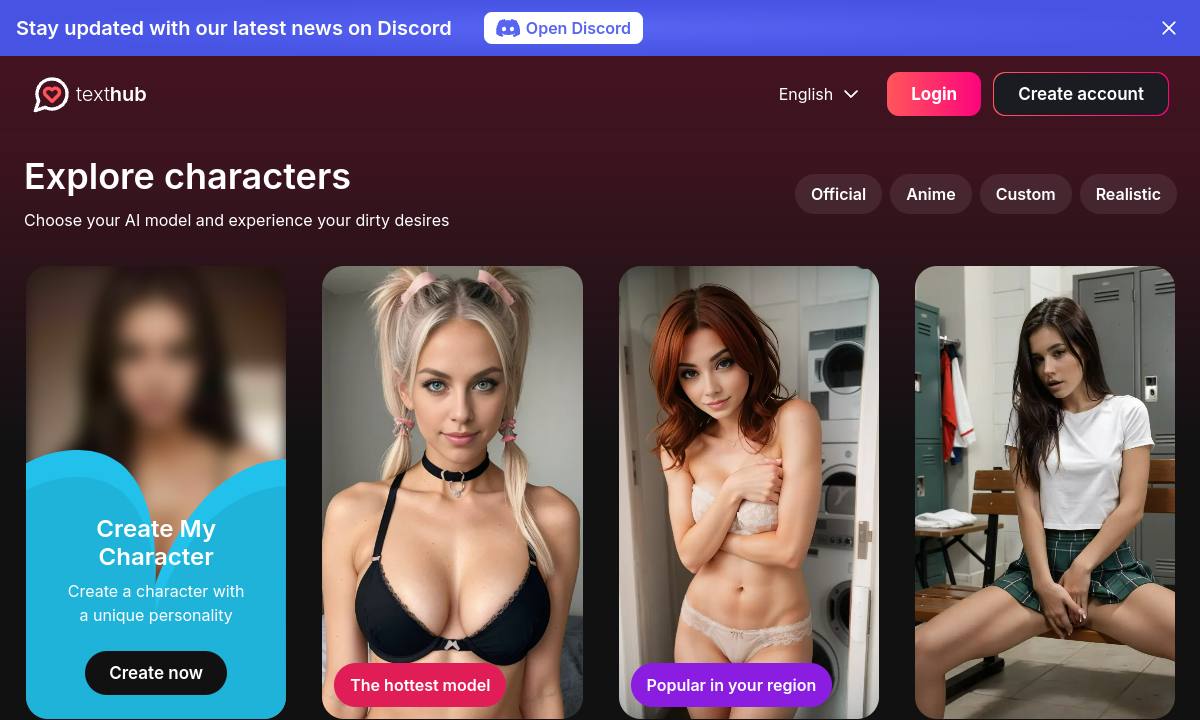
TextHub's front page hits you with scenario-driven character cards rather than generic avatars. Each one pitches a specific setup—caught in a locker room, yoga with a MILF, a stewardess on a long flight—complete with a first-person prompt that drops you straight into the roleplay. The design sidesteps the usual pick-a-companion-then-figure-out-what-to-talk-about problem. Every character arrives with conflict, context, and sexual tension already built in. For users who want to skip the small talk and jump into a scene, this approach cuts setup time to near zero.
The most interesting line on TextHub's homepage is 'Choose your AI model,' which claims real variation in how chats respond. Most NSFW chat platforms lock you to one backend and let you discover its limits through use. Here, the stated promise is that different models will handle dirty talk, pacing, and roleplay depth differently. Whether that means switching between fine-tuned uncensored models, GPT variants, or something proprietary is not explained on the public pages. For experienced roleplayers who already know what model behavior they prefer, the ability to pick your engine matters more than any single character card.
TextHub lets you 'create a character with a unique personality,' which is table stakes for this category but still the feature that separates one-platform users from serial experimenters. The real question is how much control the personality editor gives you—tone, kink, backstory, speech pattern—and whether those settings actually hold through a long conversation. The homepage does not detail the creation workflow, so anyone planning to build original characters rather than browse community offerings should sign up and test personality persistence before investing serious time in a custom build.
The catalog summary promises pictures alongside chat and roleplay, placing TextHub in the visual-plus-text category that OurDream and GirlfriendGPT also occupy. Generated images mid-conversation change the rhythm of NSFW roleplay: a character describing what she is doing is one thing, seeing it rendered is another. The practical question is whether images are free, credit-gated, or locked behind a paid tier, and the homepage does not answer. Visual output quality, consistency with the character's described appearance, and response time will determine whether the pictures enhance the fantasy or break immersion.
A Discord link on the homepage points to a community layer, though the public pages do not clarify whether that means character sharing, feature requests, update logs, or all three. Community-driven character libraries are a genuine draw in this space—CrushOn AI's appeal partly rests on user-created cards that establish voice, conflict, and desire beyond what a solo creator would script. If TextHub's Discord is active and welcoming, it could function as an unofficial discovery feed for fresh scenarios and archetypes the front page does not showcase.
TextHub's strongest hook is scenario-first browsing: you do not pick a pretty face and hope for chemistry, you pick a situation and see who shows up inside it. That changes the first thirty seconds of every session. The weakness is opacity—no pricing, no clear free-tier limits, no explanation of what model selection actually offers under the hood. A buyer who values jumping into pre-built fantasies with minimal preamble will find the front page inviting. A buyer who wants to understand costs and customization depth before committing will need to create an account and explore before spending.
Merits
- Pre-built scenarios include conflict, resistance, and power dynamics—not just appearance descriptions—so chats have somewhere to go from the first message
- Model selection lets you tune chat engine behavior to your preferred pacing, explicitness, and roleplay depth instead of accepting one backend blindly
- Character creation enables custom fantasies the public catalog does not cover, supporting niche or personal scenarios beyond community-built cards
- In-chat pictures add a visual layer to text-based encounters, shifting the roleplay rhythm between written narration and generated imagery
Disadvantages
- Zero pricing information on public pages makes cost comparison impossible before you hand over an email address
- Model selection is promised but completely unexplained—no named engines, no behavior descriptions, no stated context windows or memory limits
- Some character cards reference real Instagram handles, which creates an unresolved question about how character assets are sourced and whether consent is documented
- Image generation quality, per-image credit costs, and response time remain undocumented on the site
Key Features
Scenario-Driven Character Cards
Each card arrives with a specific setup, conflict, and first-person prompt so you enter a roleplay scene immediately rather than negotiating an opening line
AI Model Selection
Choose between different chat engines to match model behavior to your preferred pacing, tone, and level of explicit detail
Character Creator
Build original AI companions with defined personality traits for fantasies the public catalog does not cover
NSFW Chat With Pictures
Conversations can include generated images that visualize scenes mid-roleplay, adding a visual layer to text-based encounters
Character Discovery Feed
Browse a catalog of pre-built characters organized by scenario and archetype to find setups that match your specific interests
Discord Community
Follow platform news and connect with other users through the linked Discord server for updates and character sharing
Editor Score
TextHub's scenario-first character cards solve the cold-start problem that plagues generic AI companion apps—every entry point has conflict and desire baked in. The model selection promise, if substantiated, gives power users a control lever most competitors lack. But the complete absence of pricing, feature limits, and engine details from the public pages means you are signing up blind. Worth an account if the front-page scenarios speak to your tastes; hold off on payment until you can verify what your money actually buys.
| Criterion | Score |
|---|---|
| Scenario Entry Speed | 16 / 20 |
| Engine Flexibility | 13 / 20 |
| Visual Chat Integration | 12 / 20 |
| Pricing Transparency | 4 / 20 |
| Character Catalog Breadth | 15 / 20 |
| Total | 60 / 100 |
Rate Plans
TextHub publishes no pricing on its public pages—no free-tier limits, no subscription costs, no credit or coin structure. You cannot compare value before creating an account. The practical move: register with a secondary email, explore the free experience, check what model selection and image generation actually require, and compare against CrushOn AI's $5.99 Standard tier or GirlfriendGPT's checkout pricing before entering any payment details.
| Plan | Price | Who it suits |
|---|---|---|
| Free access | Shown after sign-in | No public details on message limits, available models, or image generation credits |
| Paid plans | Shown after sign-in | Subscription or credit structure not published on any public page |
Verify renewal terms, refund policy, and whether image generation consumes separate credits before subscribing. No billing details are available on TextHub's public pages.
Alternative Tools
| Tool | Why compare it |
|---|---|
| CrushOn AI | CrushOn AI publishes clear pricing from $0 to $14.99/month with named model tiers (Free, Pro, Ultra), group chat, world cards, and 8K–16K memory windows. TextHub's model selection claims similar flexibility, but CrushOn lets you compare features across tiers before signing up. If knowing exactly what you are paying for matters as much as the roleplay itself, CrushOn removes the guesswork TextHub currently requires. |
| GirlfriendGPT | GirlfriendGPT shares TextHub's character-first browsing philosophy—pick a scenario, jump into chat, optionally generate images. The key difference is that GirlfriendGPT shows pricing at checkout, while TextHub hides all cost information behind registration. Both platforms offer character creation for custom fantasies. If you want visual media integrated into roleplay with transparent credit costs, GirlfriendGPT is the safer first stop; if TextHub's scenario cards feel more specific to your tastes, it is worth the sign-up. |
| OurDream AI | OurDream AI at $19.99/month packages chat, images, voice calls, and short video into a single companion relationship with coin-based media costs on top. TextHub covers chat and pictures but has not published whether video or voice features exist. If you want a single AI companion who can talk, text, generate images, and appear in video clips, OurDream's multimodal stack is more complete. If you only need text and pictures with scenario-driven browsing, TextHub is the lighter option. |
Frequently Asked Questions
Is TextHub free to use?
TextHub does not publish pricing or free-tier limits on its public pages. Create an account to see what is available at no cost and what requires payment.
Can you create custom characters?
Yes. TextHub's homepage includes a character creation feature that lets you define a unique personality for original AI companions.
Does TextHub generate images during chat?
The platform's catalog summary mentions pictures as part of the chat experience. Details on image quality, credit costs, and generation speed are not available on the public pages.
What AI models does TextHub offer?
The homepage states you can 'choose your AI model' but does not name specific models or explain differences in behavior, context length, or capability.
Is there a community around TextHub?
A Discord link is present on the homepage for news and updates. The extent of community character sharing or feature discussion is not detailed on the site.
How does TextHub compare to CrushOn AI?
CrushOn AI publishes clear tiered pricing ($0–$14.99/month) with model switching, group chat, and world cards. TextHub's model selection is promised but unpriced. Choose CrushOn if budget transparency and community features matter; try TextHub if its scenario-first character cards better match your tastes.