Contents
- What Candy AI means by a Digital Twin
- What the Digital Twin Disclaimer establishes
- What the disclaimer does not prove
- Published commitments, available evidence, and open questions
- What could “significant control” mean?
- Model use, character data, and the end of an agreement
- Approval, correction, and complaint handling
- Why AIrotic connected Digital Twins with Candy AI’s 2257 language
- How users can evaluate a Candy AI Digital Twin
- Where the policy still needs detail
Candy AI defines a Digital Twin as an AI character depicting a real existing person. In a Trust & Safety article updated November 16, 2026, operator EverAI says it publishes these characters only with the person’s explicit consent, under a written contract, and with “significant control” given to that person. EverAI also says every Digital Twin chat begins with a notice that the content is AI-generated.
The Digital Twin Disclaimer tells users they are interacting with generated content rather than messaging the depicted person directly. Its meaning is limited. The notice does not prove that consent was valid, reveal what the contract permits, show who approved a particular reply, or explain what happens to the character and its data after an agreement ends.
The policy adds a useful disclosure while leaving important questions about control, data use, revocation, enforcement, and complaints unanswered.
What Candy AI means by a Digital Twin
“Digital twin” has several meanings in technology. Under this policy, it refers to an AI character whose identity and presentation depict a real, living person—not an industrial simulation or an ordinary fictional AI companion.
A fictional character can usually be managed through platform rules and its creator’s design choices. A real-person character raises further questions: Did the person authorize the likeness? Which traits and uses did they approve? Can they correct unwanted behavior or withdraw permission? What happens to conversations, generated media, and character data afterward?
EverAI’s Digital Twins policy provides a high-level framework. According to the operator:
-
A Digital Twin is developed and published only with the depicted person’s explicit consent.
-
A written contract with that person governs the arrangement.
-
The person has “significant control” over the Digital Twin.
-
Every chat begins with a Digital Twin Disclaimer stating that its content is AI-generated.
-
Additional in-product notices identify generated content as AI-generated.
These are published commitments from the operator. The policy page and supplied reporting do not provide public access to signed contracts, consent records, approval logs, technical controls, or audits for individual Digital Twins. The existence and terms of those materials therefore have not been independently inspected through the available sources.
Readers looking for context on Candy AI’s wider companion experience can consult NSFWAItool’s Candy AI review and Candy AI directory page. The Digital Twins policy covers the narrower issue of real-person AI characters.
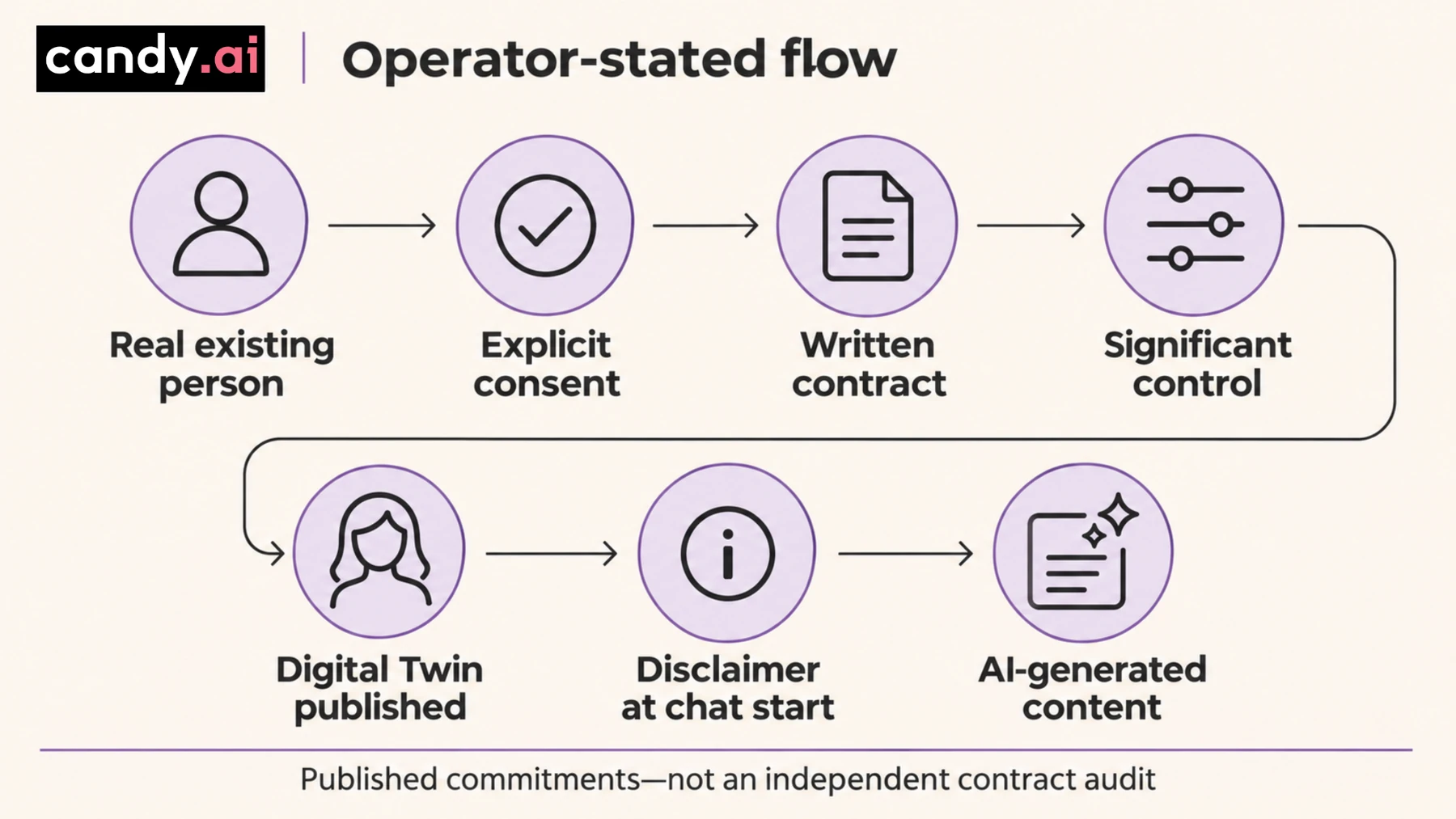
Candy AI’s operator-stated Digital Twin commitments, shown as a consent-to-disclosure flow; these published commitments are not an independent audit of contracts or controls.
What the Digital Twin Disclaimer establishes
The disclaimer is an identity and provenance notice. It addresses a potentially consequential misunderstanding before the conversation develops.
When clearly displayed at the start of a chat, it communicates three practical points:
- The character depicts a real person.
- An AI system generates the conversation.
- The messages are not direct statements written in real time by the depicted person.
This distinction changes how users should interpret apparent opinions, promises, preferences, emotional reactions, and autobiographical details. A reply may follow the character’s configuration without having been personally composed or reviewed by the person it depicts.
Timing matters. A notice shown before or at the beginning of an interaction reaches users when confusion is most likely to arise. A statement buried in general terms is easier to miss. Nearby product labels can reinforce the disclosure when a character produces images, voice, or other media.
To work properly, the notice should be conspicuous, readable, and tied to the specific character. A general statement that “some content may be generated” conveys less than a notice identifying the current character as a Digital Twin.
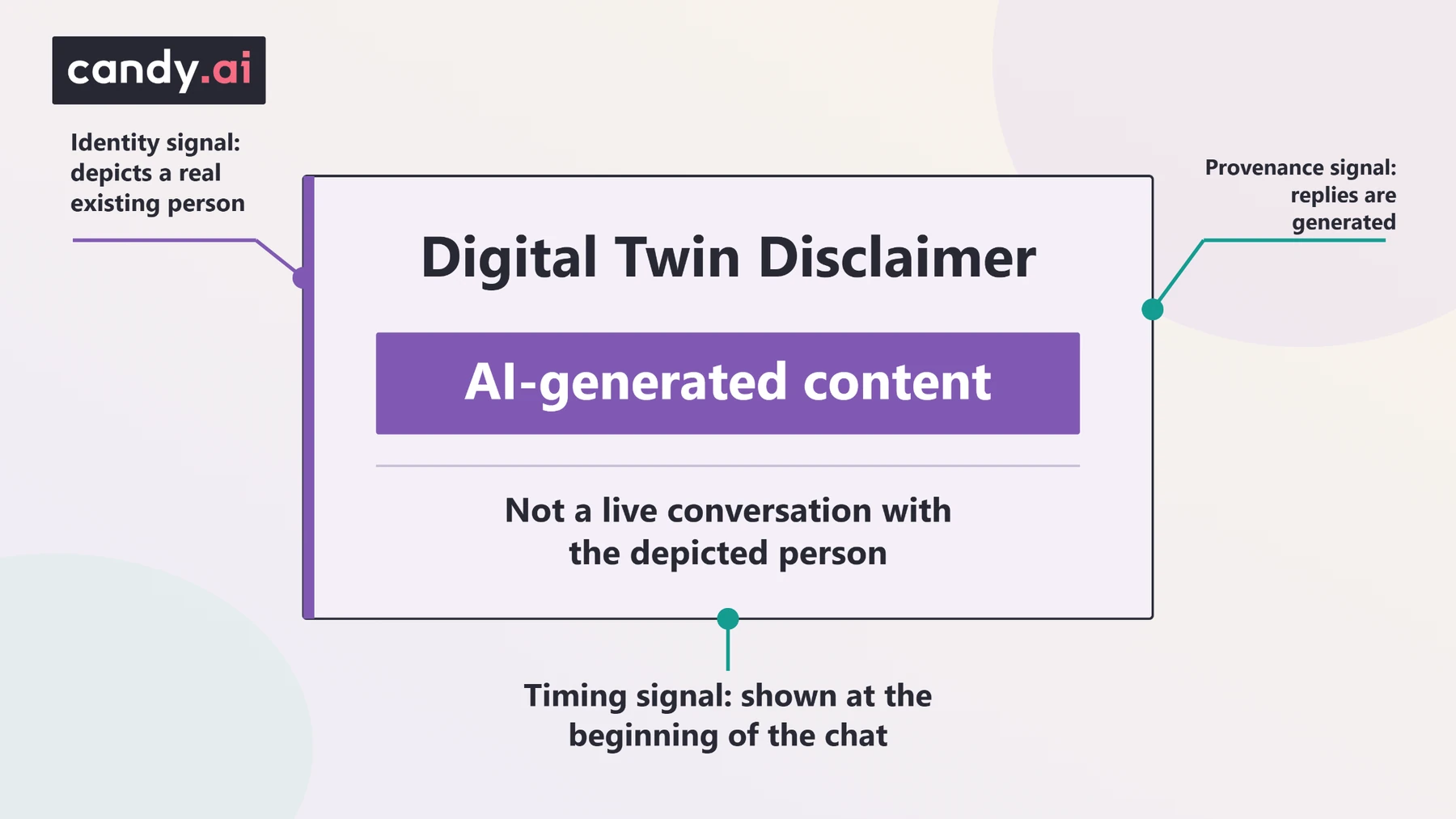
Content anchor: the three practical signals established by Candy AI's Digital Twin Disclaimer—identity, AI provenance, and disclosure timing.
What the disclaimer does not prove
A disclosure label is not evidence of the underlying authorization process. Even if the notice appears exactly as EverAI describes, it does not independently establish:
- who signed the agreement or how that person’s identity was verified;
- whether consent covers chat, images, voice, video, marketing, and every available output type;
- how long the agreement lasts or how compensation works;
- whether the person approved the character’s prompts, boundaries, or individual responses;
- whether source material can be used to train or improve other models;
- whether consent can be withdrawn and how quickly withdrawal takes effect;
- what happens to previously generated content after termination;
- whether the platform audits compliance with the agreement; or
- which remedies apply if the twin misrepresents the person.
Nor does the label make every generated statement an endorsed statement. If a Digital Twin claims that the person holds a particular opinion, attended an event, offers an off-platform service, or promises contact elsewhere, users should not assume personal approval solely because an authorized likeness arrangement may exist.
The narrow reading is: “This is an AI representation, not a live conversation with the person.” It does not mean: “The person reviewed and approved everything this character can say.”
Published commitments, available evidence, and open questions
| Issue | What the operator publishes | What the available material independently establishes | What remains open |
|---|---|---|---|
| Consent | Digital Twins are published only with explicit consent | The policy publicly makes this commitment | How consent is recorded, scoped, renewed, and audited |
| Contract | A written contract exists with the depicted person | The requirement appears on the policy page | Contract duration, compensation, termination, remedies, and permitted uses |
| Control | The person receives “significant control” | That phrase is part of the published policy | Which controls exist and whether they include approval, correction, suspension, or deletion |
| Disclosure | Every chat begins with a Digital Twin Disclaimer, with additional in-product notices | The operator describes this disclosure system | Consistency across devices, media types, languages, and individual twins |
| AI output | The disclaimer says chat content is AI-generated | The disclosure’s stated purpose is clear | Whether particular outputs are reviewed, restricted, logged, or corrected |
| Data lifecycle | The cited policy summary supplies no detailed lifecycle | The available material includes no public contract or technical audit | Training use, retention, portability, deletion, and post-contract use |
This distinction does not imply that the commitments are false. It simply marks the limit of what a short public policy demonstrates. The policy states the rules; assessing how consistently they are implemented would require further information.
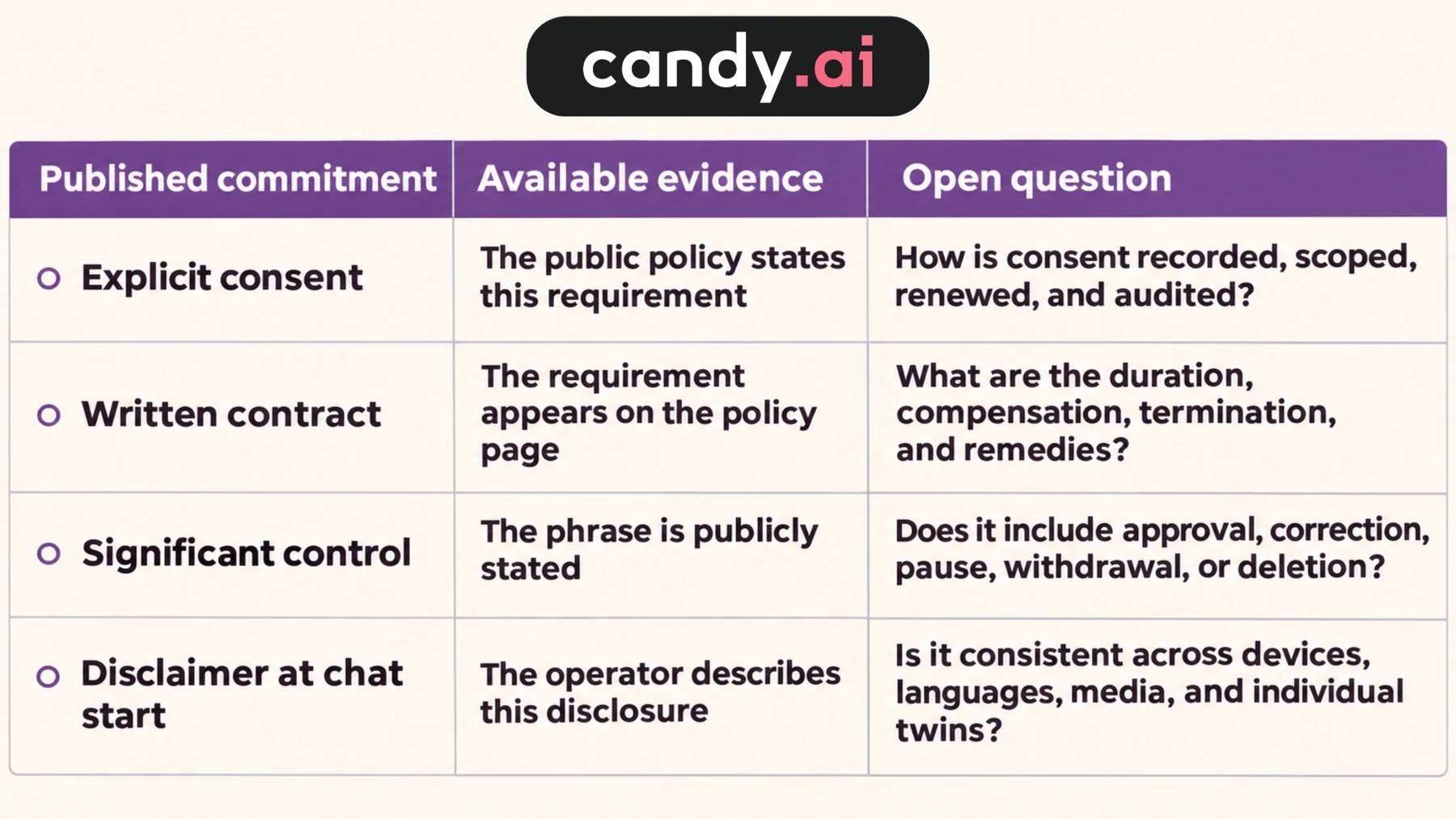
The public policy states these commitments, while implementation details such as consent records, contract terms, control mechanisms, and disclosure consistency remain open.
What could “significant control” mean?
“Significant control” is the policy’s most important undefined phrase. In a real-person likeness arrangement, control could apply before launch, during operation, and after the relationship ends.
Before launch, the depicted person might approve the name, photographs, voice materials, biography, conversational boundaries, prohibited topics, media formats, and marketing presentation. Operational controls might allow the person to review outputs, correct false biographical claims, change boundaries, pause the character, reject promotions, or escalate misuse. End-of-agreement controls could cover withdrawal of the character, restrictions on retained assets, and treatment of material already generated.
These are examples of what meaningful control could include, not claims about the rights Candy AI actually grants. The published summary does not say whether “significant control” includes all, some, or entirely different mechanisms.
The difference between consultation and authority matters. An invitation to suggest changes does not necessarily include an enforceable right to require a correction. Likewise, stopping new chats would not answer whether old conversations, media, model adaptations, or promotional pages remain available.
A fuller policy would clarify at least five points:
- Which elements require the person’s approval before launch?
- Can the person inspect and correct the twin’s behavior after launch?
- Can the person pause the twin immediately while a dispute is reviewed?
- Can consent be revoked, and on what timeline?
- What data or content may remain after the contractual relationship ends?
Model use, character data, and the end of an agreement
A Digital Twin may rely on several categories of information: identity details, approved biographical material, photographs, recordings, character instructions, safety rules, user conversations, and feedback about generated responses. A high-level consent statement does not explain how the platform processes each category.
One central question is whether likeness materials are used only to operate that person’s character or may also support the training, fine-tuning, evaluation, or improvement of wider systems. Other unresolved points include which vendors can process the data, how long source files and derived representations are retained, and whether backups follow a separate deletion schedule.
Termination adds further questions. Blocking future access to a character does not necessarily delete source material or remove derived model data. It also does not determine what happens to media generated by users while the agreement was active.
A clear post-agreement process would distinguish among:
- delisting the Digital Twin;
- preventing new conversations and generations;
- retaining or deleting source likeness material;
- retaining or removing derived character configurations;
- handling copies in backups and service-provider systems; and
- governing content users previously generated or downloaded.
These details affect the depicted person and users deciding how much personal information to share in chat. NSFWAItool’s privacy checklist for adult AI tools outlines what to examine before submitting sensitive prompts, source media, or payment information.
Approval, correction, and complaint handling
AI characters can produce a wide range of replies, so line-by-line approval in advance is unlikely unless a platform explicitly promises it. The practical questions are how the system detects and corrects errors and boundary violations after initial authorization.
The Digital Twins summary does not describe a complaint workflow. A useful explanation would identify who can report a problem, which reporting category to select, whether the depicted person has a dedicated escalation route, what evidence is needed, and what interim measures the platform can take.
A complaint might concern a missing disclaimer, a false biographical claim, an output outside approved boundaries, an unauthorized image or voice, or a twin that remains available after permission is disputed. An effective process would connect the report to a reviewable character and output, preserve relevant records, limit repeated exposure, and communicate the result.
When reporting a disputed response, users can record the character name, date, visible disclosure, relevant output, and report reference without unnecessarily republishing sensitive material. They should also distinguish deletion of a visible conversation from deletion of data stored elsewhere. The guide to AI companion chat-deletion evidence explains why a “deleted” confirmation may document an interface action without addressing retention, memory, backups, or derived records.
Why AIrotic connected Digital Twins with Candy AI’s 2257 language
In reporting published November 17, 2026, AIrotic pointed to an apparent tension between the newly documented real-person Digital Twins and Candy AI’s published 18 U.S.C. 2257 exemption statement.
The two documents address related but distinct subjects. One describes AI characters depicting real existing people under consent and contract arrangements. The other states Candy AI’s position on an exemption from federal recordkeeping requirements associated with certain visual depictions. Reading them together prompts questions about how the operator categorizes Digital Twin outputs, source materials, the platform’s role, and the role of the depicted people.
The presence of a real person’s likeness does not by itself determine whether a particular statute or recordkeeping duty applies. An AI depiction, a source photograph, a generated output, and a depiction of actual conduct are different concepts. Application may depend on the content, production process, underlying facts, and legal definitions that the short policy pages do not resolve.
AIrotic therefore identifies an issue that would benefit from a clearer explanation by the operator. The available material does not establish a legal conclusion about compliance, exemption status, or the application of 18 U.S.C. 2257 to every Digital Twin or output.
Useful clarification would explain how Candy AI distinguishes wholly generated media from source material involving real people, how it verifies age and identity where relevant, which records it retains under its own policies, and how Digital Twin contracts interact with its exemption position.
How users can evaluate a Candy AI Digital Twin
Users do not need access to a private contract to make better-informed decisions. Several visible checks can show whether the published framework is being communicated consistently.
-
Confirm that the disclaimer appears before the conversation develops. It should clearly identify the character as an AI depiction and the content as generated.
-
Read the notice narrowly. It discloses AI mediation; it does not prove that the person personally approved every response.
-
Check the context provided with other media. Moving from chat to images, voice, or video should not erase the distinction between generated output and direct communication.
-
Verify consequential biographical claims elsewhere. Use an authenticated external channel associated with the real person or platform instead of relying on the Digital Twin’s reply.
-
Review privacy and deletion controls before sharing sensitive details. Look separately at chat history, saved memory, uploaded files, generated media, and account deletion.
-
Document discrepancies precisely. Save the character identifier, notice, relevant output, time, and report reference when a representation appears misleading or disputed.
-
Use the platform’s reporting route. Describe the specific issue, such as a missing disclosure or false personal claim, rather than assuming the general AI label resolves it.
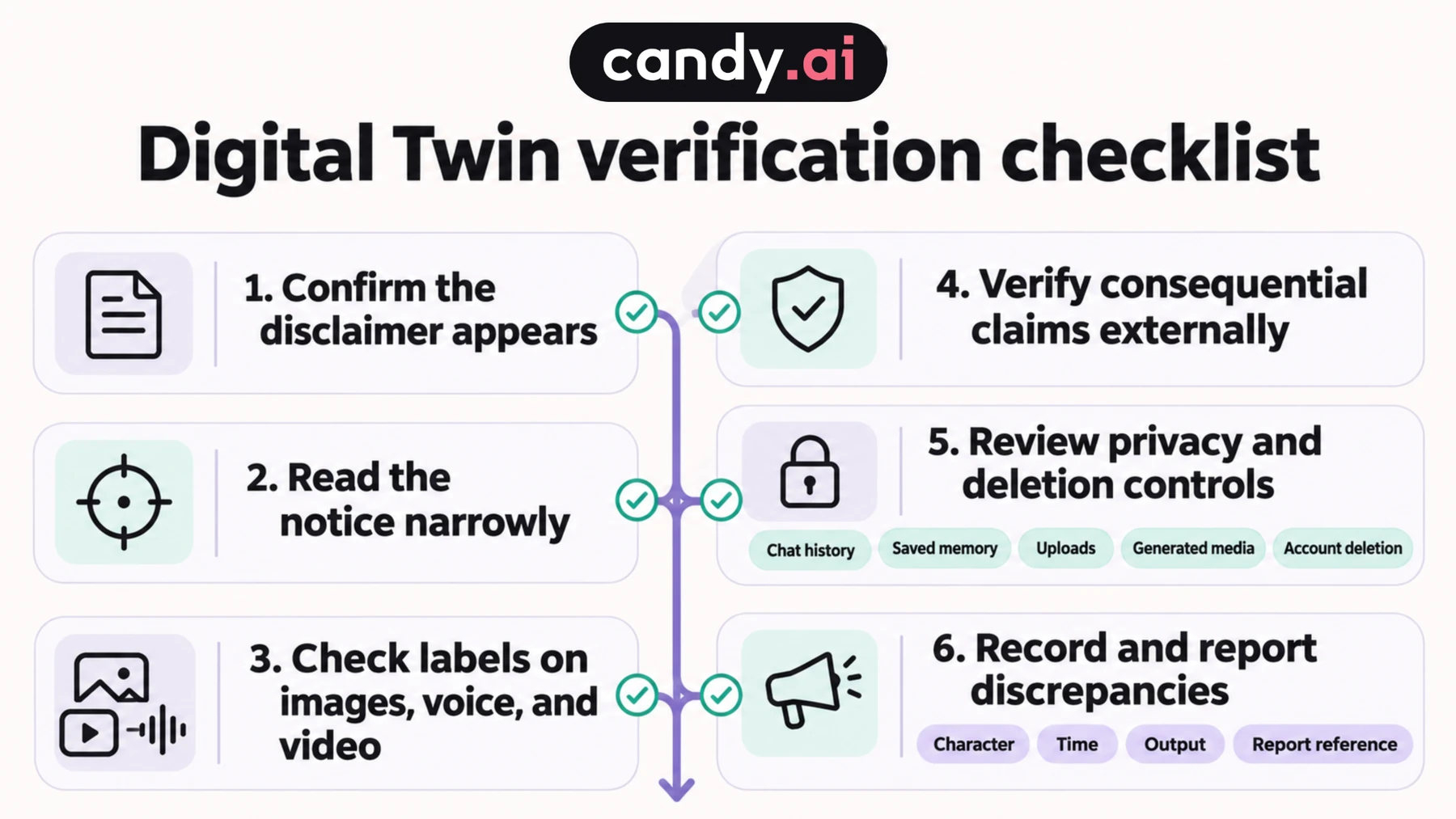
A practical sequence for evaluating disclosure consistency, protecting chat data, and recording disputed Digital Twin representations.
Where the policy still needs detail
Candy AI’s Digital Twins policy makes four notable public commitments: explicit consent, a written agreement, significant control for the depicted person, and an AI-generated-content notice at the beginning of every chat. The disclaimer can reduce identity confusion by telling users that they are interacting with an AI representation rather than the person depicted.
That is the extent of what the notice itself establishes. It does not disclose the contract, demonstrate the scope or continuing validity of consent, show approval of individual outputs, define correction rights, explain model and data use, or settle what happens after an agreement ends. The complaint process and the relationship between Digital Twins and Candy AI’s 2257 exemption language also remain unclear.
The policy’s practical value will depend on its implementation: how consent is documented, which controls the depicted person can exercise, how errors are corrected, how data is handled, and whether the person can effectively pause or revoke a twin when circumstances change.