Contents
- What Chapter 11 Means Here
- Keep the Metrics Straight Before Comparing Anything
- The Filing-Era Economics
- Why 12 Million MAU and a 22 Million Peak Are Not the Same Measurement
- The Two Structural Problems
- The Market Did Not Disappear
- From Chat to Interactive Content
- What Tipsy Chat and Zeta Changed
- Common Misunderstandings
- What This Means for the Category
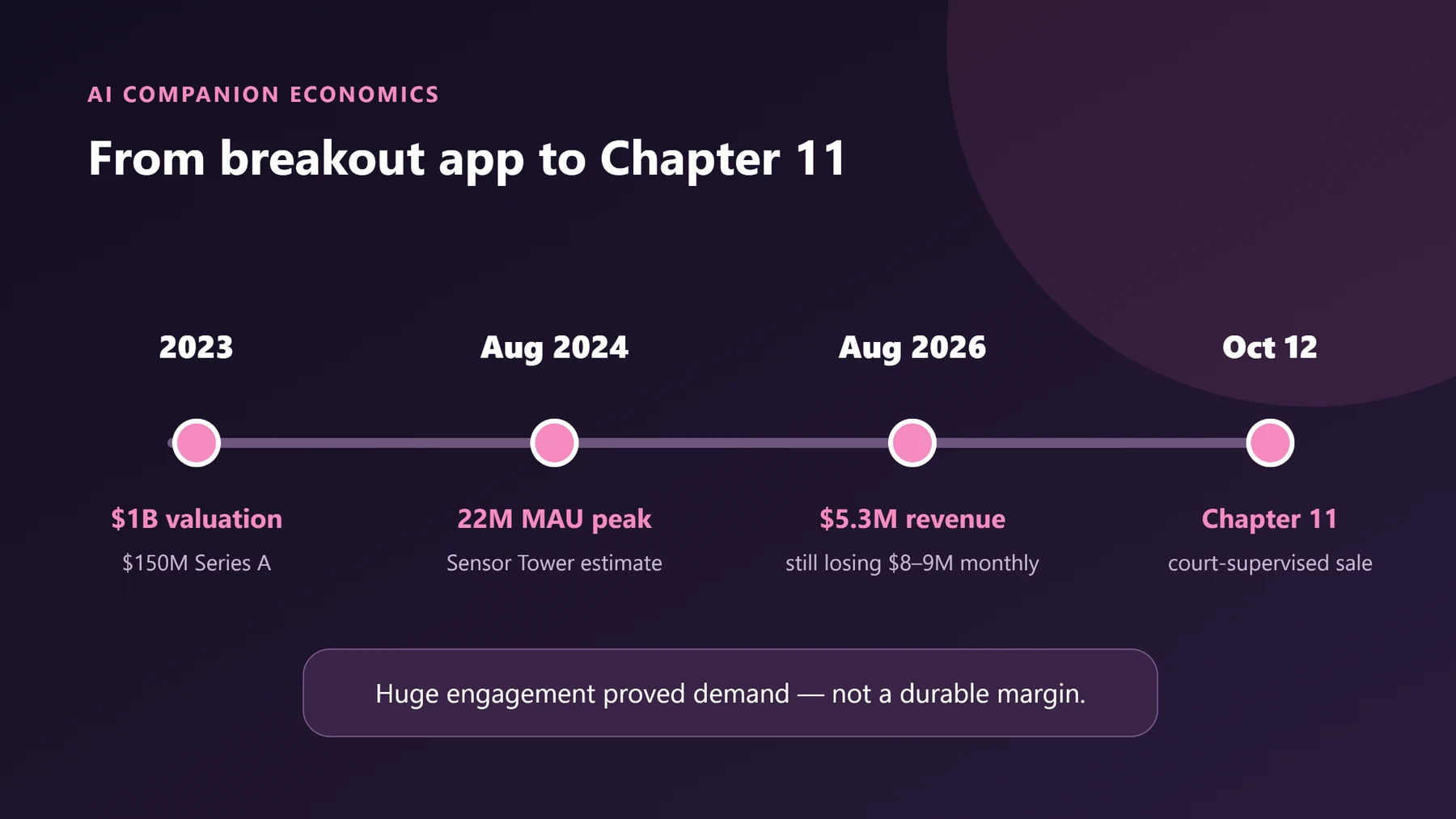
On October 12, 2026, Character.AI filed for Chapter 11. The company that proved millions of people would spend hours talking to fictional AI characters entered a court-supervised sale process, while Zeta, Tipsy Chat, Crushie AI, CHAI and a wave of newer companion apps were pulling in real consumer spending. The demand was never the problem. The monetization model was.
Character.AI's Chapter 11 does not mean people stopped wanting AI companions. It means the first commercially dominant way of selling them — unlimited chat on a flat subscription, propped up by characters the platform did not own — could not survive contact with its own inference bills. Apps that sell structured stories, generated images, choice prompts and virtual currency kept growing through the same period. AI companionship did not fail; the first monetization model did.
What Chapter 11 Means Here
The word "bankruptcy" does a lot of misleading work in headlines, so it is worth pinning down what this filing actually is.
Chapter 11 is a court-supervised sale and reorganization process, not an automatic shutdown order. Character.AI has said the platform remains operating while the sale proceeds. The company is seeking a viable continuation bid — a buyer or structured transaction that can carry the product forward. It has also stated that if no viable continuation bid emerges, the platform may be wound down.
Three states are in play at once:
- Operating during the sale. Users can still log in. The service is not legally required to go dark on filing day.
- Sale in progress. The court process exists to find the best path for creditors and assets, which may include a going-concern buyer.
- Conditional wind-down. A shutdown is a stated possibility if no viable continuation bid appears. It is not a scheduled or announced date, and no reliable one exists in the record.
For readers, the practical implication is straightforward: if you use Character.AI, follow official updates rather than social posts. The company's own notices are the authoritative signal for what happens next.
Keep the Metrics Straight Before Comparing Anything
Most bad takes on this filing come from treating unlike figures as if they measure the same thing. Before any comparison, label the metric, the period, and who reported it.
| Figure | What it measures | Period | Source type |
|---|---|---|---|
| ~$5.3M monthly revenue | Company revenue | August 2026 | Filing-era figure |
| ~$13.3M operating expenses (excl. legal fees) | Company spending | August 2026 | Filing-era figure |
| ~$8–9M operating loss | Revenue minus operating expenses | Per month, August 2026 | Filing-era figure |
| $56.1M compute cost (~45% of operating expenses) | Infrastructure spend | January 1 – August 31, 2026 | Filing-era figure, eight-month total |
| ~12M MAU | Monthly active users | Stated in the first-day declaration | Company filing |
| 22M MAU peak | Estimated peak monthly actives | August 2024 | Earlier third-party estimate |
| $162.8M across 214 apps | Mobile gross consumer spend | First half of 2026 | Appfigures estimate |
| $120M annualized revenue run-rate | Company-reported forward annualized rate | October 2026 | Company-reported (CHAI) |
| KRW 70.9B revenue / KRW 5.2B operating profit | Corporate financial results | First half of 2026 | Corporate report (Scatter Lab / Zeta) |
There is no single "market size" number on that list that means everything at once. Monthly revenue is not first-half app spending. An annualized run-rate is not a completed-year result. An MAU count from a court declaration is not the same instrument as a third-party traffic estimate from two years earlier. Hold those distinctions and the filing becomes readable; drop them and you can "prove" almost any headline you want.
The Filing-Era Economics
The core arithmetic of the business as the filing presents it for August 2026:
| Item | Figure |
|---|---|
| Monthly revenue | ~$5.3M |
| — Subscriptions | ~$2.8M |
| — Advertising | ~$2.5M |
| Operating expenses (excluding legal fees) | ~$13.3M |
| Operating loss | ~$8–9M per month |
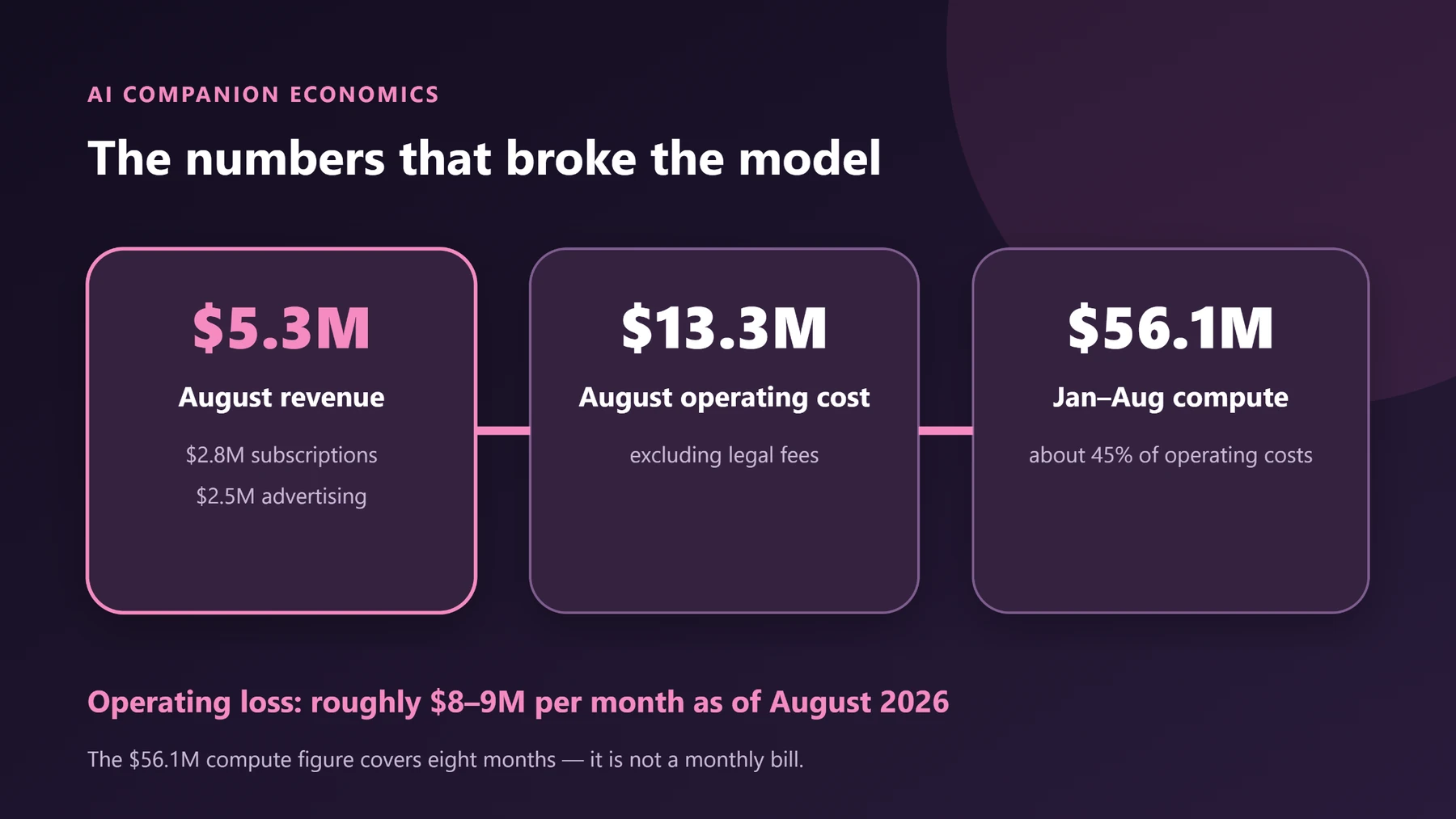
Revenue split roughly evenly between subscriptions and advertising. Operating expenses excluding legal fees ran about $13.3M. The result: an operating loss of roughly $8–9 million every month. In the filing's framing, August was not an anomaly — it was a representative slice of a structurally unprofitable month.
Then the number most coverage has gotten wrong: $56.1 million in compute cost covers January 1 through August 31, 2026 — eight months — and represented about 45% of operating expenses. It is not a one-month bill. That correction matters both ways. It is not the absurd single-month figure some readers first assume, and it is not a rounding error either. Compute consuming nearly half of operating expenses over two-thirds of a year tells you the business was, in significant part, an inference resale operation with a chat interface.
A useful way to internalize this: at roughly $13.3M in monthly operating expenses excluding legal fees, an $8–9M monthly operating loss implies revenue covering well under two-thirds of the bill. Advertising is the fragile half of that mix. It monetizes attention rather than the depth of any single conversation, and it does not rise in lockstep with how much a user talks.
Why 12 Million MAU and a 22 Million Peak Are Not the Same Measurement
The first-day declaration put monthly active users at roughly 12 million. Earlier third-party estimates reported a peak of about 22 million MAU in August 2024. It is tempting to write "users fell by half." The two numbers do not support that phrasing.
The 12 million figure comes from the company's own filing-era declaration. The 22 million peak comes from earlier third-party estimates using a different methodology at a different moment in time. They are directionally suggestive — a service that once estimated 22 million actives and now declares about 12 million is plainly smaller — but they are not two readings from the same instrument.
The more important point is what the comparison obscures. User count was never the binding constraint. Unit economics were. Character.AI did not fail because too few people showed up. The filing shows the opposite: roughly 12 million monthly actives, plus years of extraordinary engagement, still produced an $8–9M monthly operating loss. Scale of attention did not convert into scale of margin. That is a business-model fact rather than a traffic fact.
The Two Structural Problems
Underneath the numbers sit two problems that no amount of user growth fixes on its own.
Problem one: popular characters the platform did not own
Character.AI's most trafficked personas were frequently built on intellectual property the company did not control — fictional characters from anime, games, films and books. That created a product engine and a liability at the same time. The characters drove discovery and retention; they also meant a large share of the platform's value sat on a foundation the platform could not exclusively monetize, license cleanly, or defend if rightsholders pushed back.
This is a structural point rather than a moral one. When your most valuable assets are rented, your negotiating position with both users and advertisers is weaker than the traffic numbers suggest. A platform that owns its characters — or whose characters are native, licensable and safe to build merchandise, media and premium tiers around — has options that Character.AI did not.
Problem two: inference cost scales with usage; flat revenue does not
Every additional conversation generates inference cost. On a flat subscription or a free unlimited tier, the heaviest users — the most valuable users by engagement — are also the most expensive users by compute. Revenue per user stays roughly constant while cost per user rises with intensity of use, and the squeeze gets worse precisely when the product is working.
The incentive loop is easy to trace. The product succeeds when users talk more. Talking more costs more. If the pricing structure does not capture that intensity, growth accelerates the loss. That is the mechanical reason unlimited chat is a risky default in consumer AI: it prices the output of the model at zero at the margin while charging a fixed price for access.
An option-based model works differently. When each extra image, each premium-model turn, each story unlock and each currency purchase carries its own price, engagement and revenue move together.
The Market Did Not Disappear
Now the other half of the contradiction. While Character.AI headed into a sale process, the category kept spending.
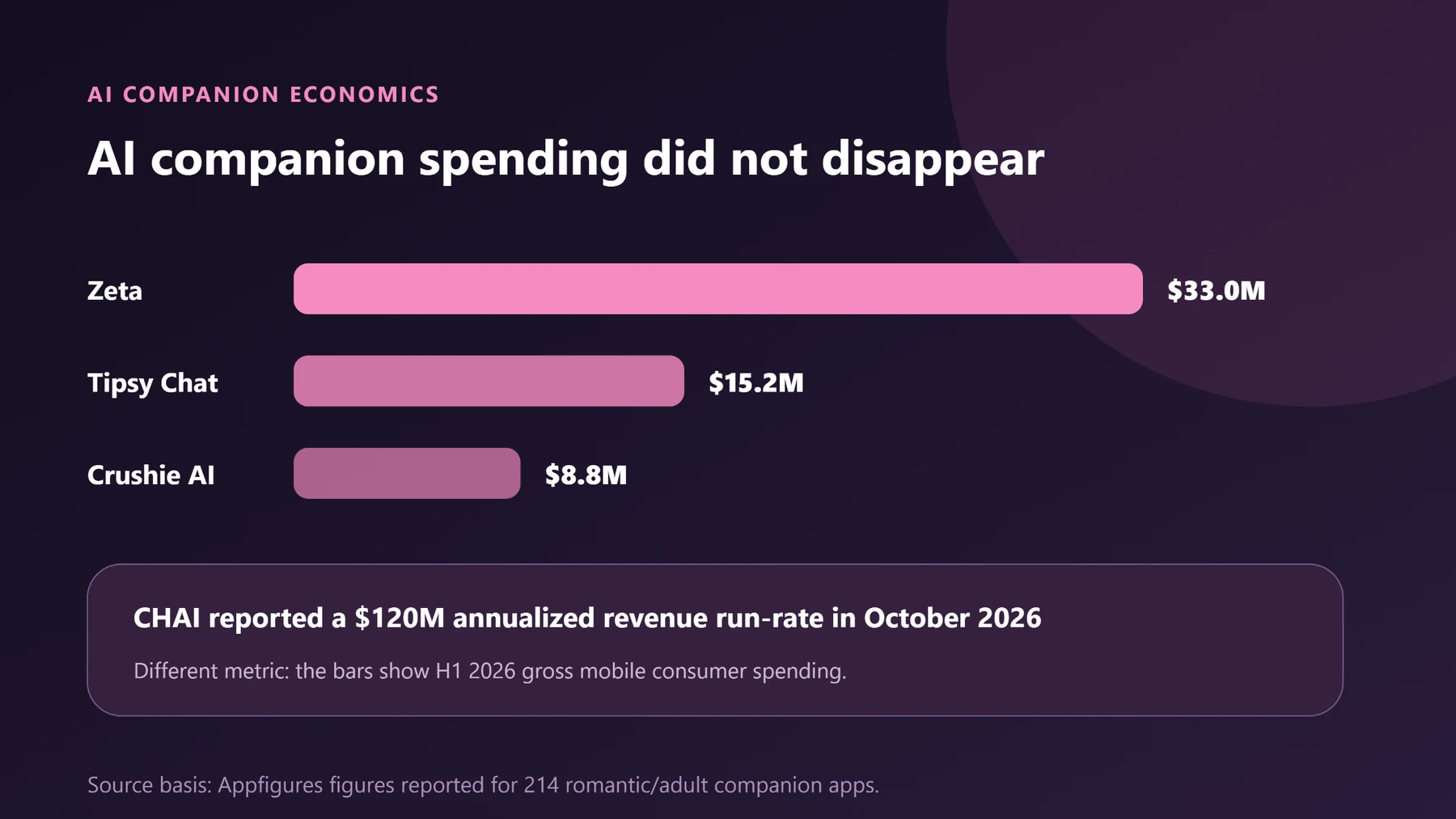
Appfigures data reported for the first half of 2026 estimated $162.8 million in gross mobile consumer spending across 214 romantic and adult companion apps. These are mobile gross consumer-spend estimates — what users paid inside the apps, not company revenue after platform fees, refunds or off-app purchases.
| Product | H1 2026 mobile gross consumer spend (estimate) |
|---|---|
| All 214 romantic/adult companion apps | $162.8M |
| Zeta | $33M |
| Tipsy Chat | $15.2M |
| Crushie AI | $8.8M |
Three products — Zeta, Tipsy Chat and Crushie AI — accounted for a substantial share of that total. And these are only the mobile side of a category where web usage, subscriptions billed elsewhere and newer entrants also sit.
Two other figures belong here, each with its own label, because they measure something different:
- CHAI reported a $120 million annualized revenue run-rate in October 2026, with a team of just 15–20 employees. This is a company-reported run-rate — a forward-looking annualization, not completed-year revenue, and not the same metric as first-half mobile gross consumer spend. The ratio still stands out: a run-rate in that range against headcount in the high teens says something about how much revenue a lean team can carry when pricing is aligned with usage. (Company facts are published on CHAI's site.)
- Scatter Lab reported first-half revenue of 70.9 billion won and operating profit of 5.2 billion won for Zeta. Those are corporate financial results for the full period, reported through financial press coverage (reported by The Seoul Economic Daily). Corporate revenue and mobile gross consumer spend are different measurement surfaces, and they should not be added together.
The Appfigures-based reporting is available in this Decrypt summary. Character.AI's own notices are at the initial Chapter 11 announcement and the subsequent sale update and transaction notice.
Read together, these figures say money kept flowing into AI companionship throughout 2026. It flowed to products with different unit economics.
From Chat to Interactive Content
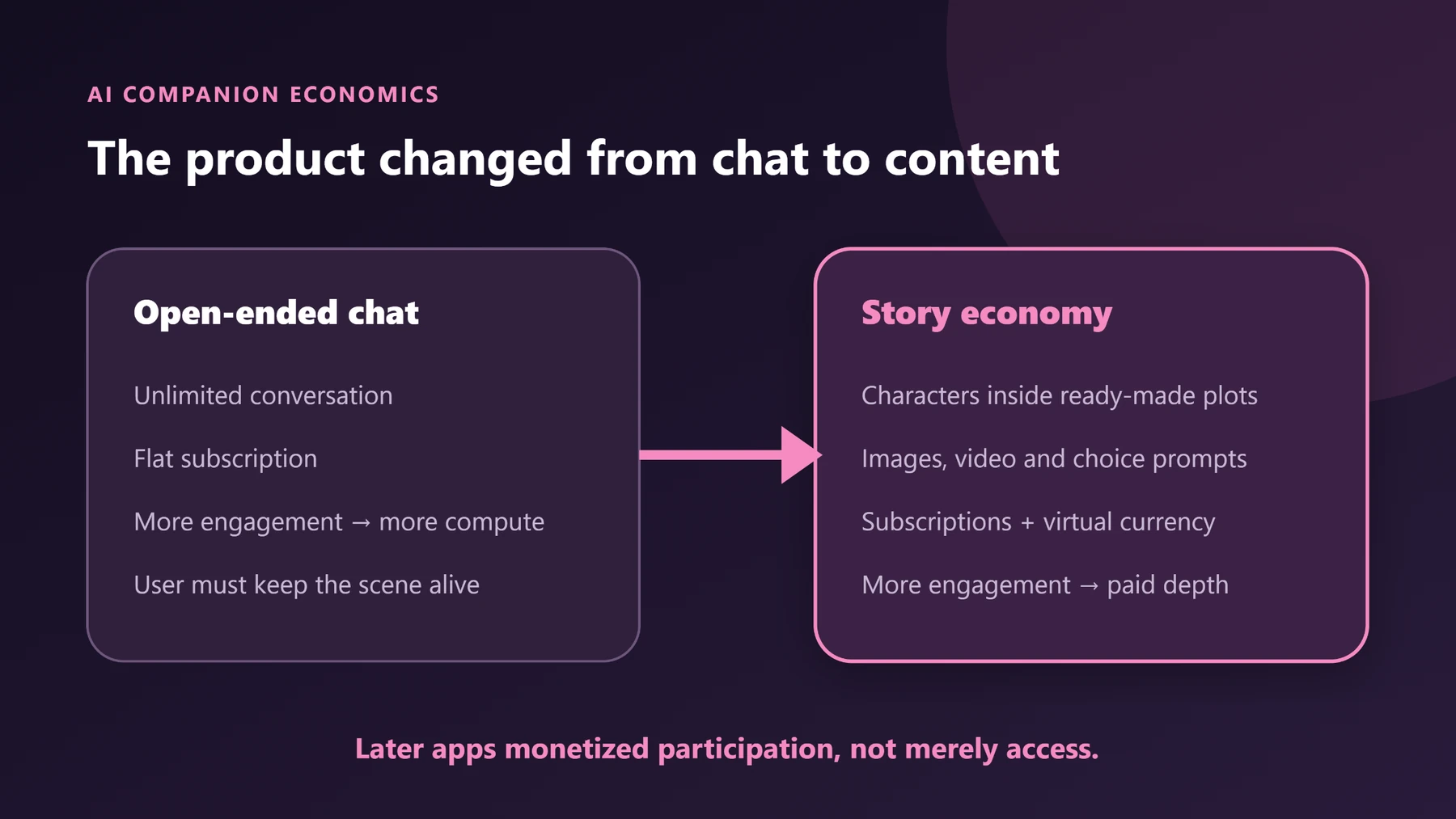
Character.AI's original model treated the user as the story writer. You bring the character, you drive the scene, you write the dialogue, and the platform supplies an essentially unlimited text stream. That worked brilliantly for engagement and poorly for pricing, because the value the user extracted most of — infinite free-form conversation — was exactly the output with the highest marginal cost and the lowest marginal revenue.
Newer apps increasingly sell structured interactive content instead:
- Story structure. Scenarios, scenes and arcs with beginnings, turns and endings — content the user consumes, not only content the user produces.
- Generated images and video. Visual output tied to the scene, which is both more engaging and more clearly a priced deliverable than a paragraph of dialogue.
- Choice prompts. Branching decisions that create anticipation, replay value and natural moments to gate a premium tier.
- Premium models. Higher-quality reasoning or voice reserved for paying tiers, so model quality becomes a sellable variable rather than a fixed cost.
- Virtual currency. Per-use spending that scales with intensity, converting the heaviest users from a cost problem into the revenue base.
The shift in the user's role carries the economics. The user moves from being solely the author to being a participant and consumer inside an experience someone else designed. The platform controls pacing, drip-feeds reveals, prices individual beats, and can attach media generation to moments of high emotional investment. Engagement then maps to monetization instead of running away from it.
What Tipsy Chat and Zeta Changed
Take the two clearest cases from the spending table.
Tipsy Chat sits at $15.2 million in estimated H1 2026 mobile gross consumer spend. The product's shape is instructive: it leans into scenario-driven, adult-flavored interactive content rather than an open-ended "talk forever" box. Users arrive for a situation, not an empty prompt. That design gives the app natural upsell surfaces — continuation, premium scenes, generated media — because the experience is already segmented into moments.
Zeta leads the table at $33 million in the same estimate, and Scatter Lab's reported first-half operating profit of 5.2 billion won on 70.9 billion won of revenue shows the model can produce margin, not just top-line spend. Zeta's reported strength is a polished, character-and-media-heavy companion loop with strong retention among its core demographic. The user is not asked to invent the entire relationship from scratch; the product supplies character, context and visual payoff, and the user steps in as the participant.
Set either against the unlimited-chat equilibrium. In a story economy, every extra session can attach to a priced beat. In an open-chat economy, every extra session is pure cost unless the user happens to upgrade for unrelated reasons. The apps that grew in 2026 made each session feel like it was leading somewhere worth paying to reach.
At the product level rather than the market level, the same pattern shows up in how SpicyChat and Candy AI differ — one leaning toward open character roleplay, the other toward an integrated chat-plus-generated-media loop — and in a closer look at Candy AI's product flow.
Common Misunderstandings
"Character.AI shut down." Not established. It remains operating during the sale process. A wind-down is a stated possibility if no viable continuation bid emerges — conditional, not scheduled. No shutdown date exists in the record, and a specific one from anyone should be distrusted.
"The AI companion market is dead." The evidence points the other way. $162.8 million in estimated mobile gross consumer spend across 214 romantic/adult companion apps in the first half of 2026, plus a company-reported $120M annualized run-rate at CHAI, plus operating profit at Zeta, all indicate a category that monetizes. The market did not disappear; the leading pricing structure did.
"It failed because of adult content." The filing-era economics do not support a single-cause story. Compute consuming ~45% of operating expenses over eight months, unlicensed character IP, and flat pricing against variable inference cost are structural problems that apply to any unlimited-chat consumer AI product, whatever its content category.
"More users would have fixed it." August 2026 revenue of ~$5.3M against ~$13.3M in operating expenses excluding legal fees shows the gap was per-unit, not per-user. Growth multiplies the sign of the unit economics; it does not change it.
"These figures are all the same kind of number." Monthly company revenue, H1 mobile gross consumer spend, an annualized company-reported run-rate, corporate financial results and MAU counts are five different instruments. Comparing them without labels is how bad analysis happens.
"The winners are just better chatbots." Unlikely. The differentiator visible in 2026 spending is product structure — priced beats, generated media, premium models and virtual currency — rather than raw conversational quality.
What This Means for the Category
For readers deciding where to spend time or money, the practical filter is straightforward. When you evaluate a companion app, ask three questions: What am I paying for, at the margin? What does the app own outright? Does my usage intensity increase its cost faster than its revenue? An app that can only answer the first question with "access" is running the model that just filed. An app that can point to specific priced moments — a scene, an image, a premium model turn, a currency purchase — is running the model that earned $162.8 million in estimated first-half mobile gross consumer spend across 214 apps.
For builders and watchers, three things are worth tracking next: whether a viable continuation bid for Character.AI emerges; whether the interactive-content pricing pattern spreads from romantic and adult companion apps into broader character and entertainment products; and whether any platform successfully attaches virtual currency to long-form story experiences without reigniting the unlimited-cost problem. Demand in this category has been proven twice over — once by 22 million estimated actives at peak, once by nine figures of consumer spending in a single half-year. What gets tested now is the pricing.
If you are browsing the current market rather than analyzing it, start with AI companions in the adult industry for the wider context, why companion AI reached a16z's top-products list for the mainstream adoption angle, or the AI sex chat site directory to compare products on memory, character control, privacy and pricing.
The demand for AI companionship held up through 2026; the model that sold it did not. Unlimited, flat-priced chat layered on rented characters and ever-rising inference bills produced an $8–9M monthly operating loss even at 12 million declared monthly actives, while apps charging for structured stories, generated media, premium models and virtual currency collected nine figures of consumer spending in six months. The category has proof of demand. The open question is which pricing structure can survive it.