
What DZMM actually is
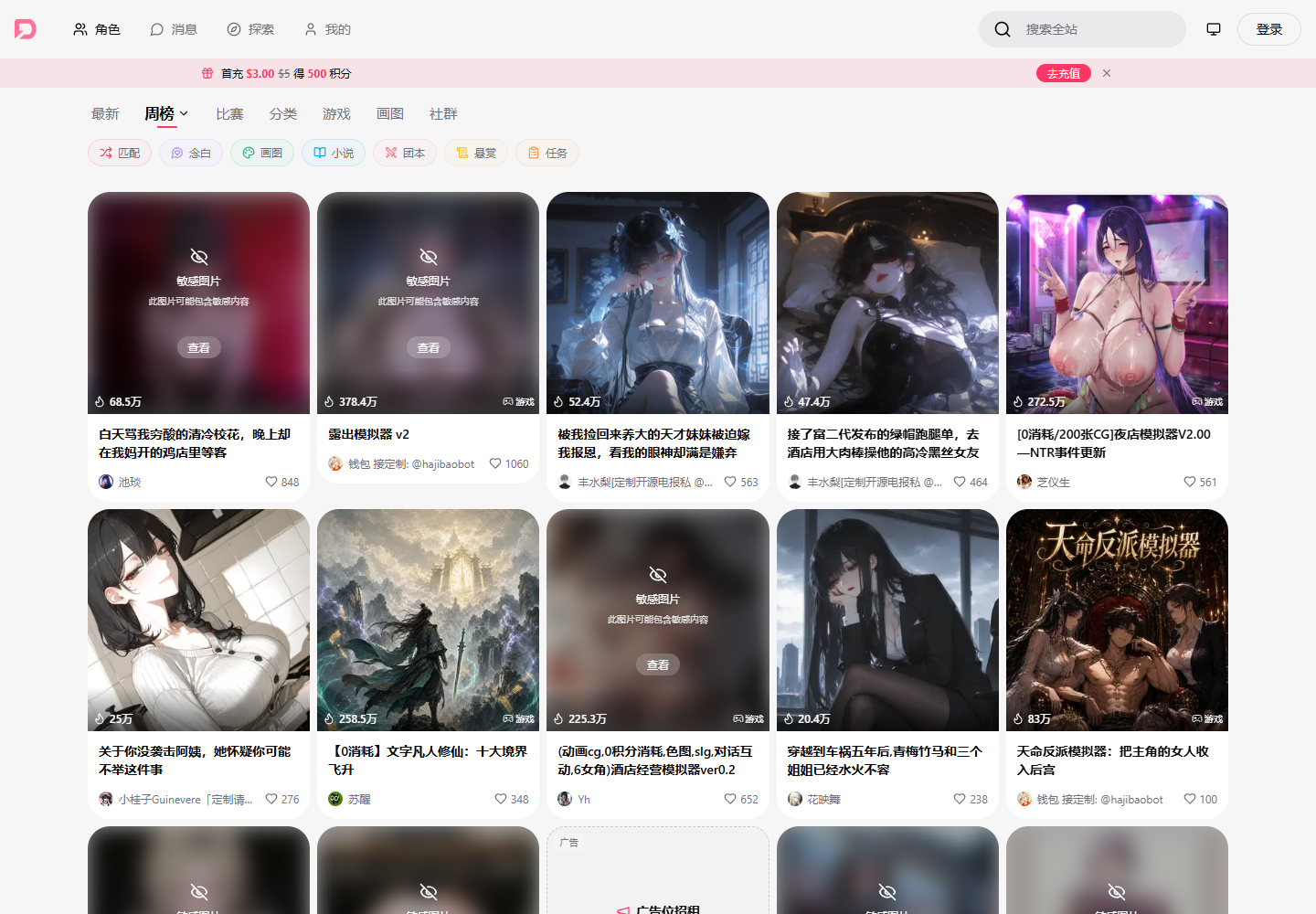
DZMM is easiest to understand as a card community with a roleplay service attached. Its front page moves constantly: new authors appear, competition entries climb the rankings, and older cards receive revised prompts, lorebooks, or new routes. The chat box matters, but the reason people return is the supply of things to play.
The library is overwhelmingly Chinese. That is useful if you want to explore the unusually elaborate cards coming out of the Chinese SillyTavern scene, but it also means international users should expect Chinese menus, creator notes, tags, and opening messages. A model can answer in another language when the card and instructions allow it; the community itself remains Chinese-first.
The character-card community is the main attraction
A DZMM card may be a single companion with one greeting, or a complete text game with several characters, status panels, branching events, and a large lorebook. Creator pages, tags, favorites, comments, themed contests, checkpoints, and bounties keep those cards in circulation after publication.
That changes how discovery works. Artwork gets the click, but the greeting, scenario, system instructions, and maintenance history determine whether a card survives a long run. Once you find an author whose style fits, following that author is usually more productive than browsing the general ranking.
How it fits the SillyTavern workflow
DZMM's main chat uses its own interface. Character cards, world books, model selection, saved chats, alternative replies, and branches are already connected to the account, so you can start without deploying SillyTavern or finding an API endpoint first.
Advanced users can open Tavern Agent, which starts a cloud SillyTavern instance. Nalang is preconfigured; third-party models still require your own endpoint and settings. This split works well: the main site is fast for ordinary cards, while the cloud tavern remains available when a card depends on presets, regex, extensions, or detailed sampling controls.
What matters during a long roleplay
Switch models without abandoning the story
DZMM lists context size, credit rate, load status, deep-thinking support, and memory support in the model picker. If a model ignores the card, repeats itself, or pushes the plot in the wrong direction, you can keep the chat and change the writer behind it.
Repair a scene instead of restarting
Messages can be edited, regenerated, continued, or saved as alternative versions. Branching from an earlier turn lets two promising story lines coexist without sacrificing the original save.
Cards can hold more than a short persona
The full editor includes personality, scenario, system instructions, keywords, detailed definitions, suggested replies, world books, voice, and backgrounds. Multi-character cards can work as simulations, management games, or ensemble stories.
Memory enhancement has stated limits
DZMM currently describes support for roughly 500 messages / 100K text on 16K models and 500 messages / 200K text on 32K models; 10K models do not support it. Cards, lorebooks, history, and the next reply still compete for the same context window.
Cloud tavern: convenient, but back it up
Tavern Agent removes the local installation step, but it is not permanent storage. DZMM warns that an instance left unused for more than 14 days may be deleted and that the service does not back up its contents.
Keep the tavern URL private: anyone with the link can enter the instance and spend its allowance. Export important cards, presets, lorebooks, and chat logs instead of leaving the only copy in the cloud.
More than one-to-one chat
DZMM also connects cards to group chat, 2–8-player sessions with an AI game master, image generation, voices, novels, and creator bounties. These are secondary to the card-and-model loop, but they give creators more ways to extend a setting and give players a reason to share checkpoints or return to an updated card.
Strengths
- A lively creator scene with new cards, contest entries, and game-style scenarios.
- Built-in models make the first run much easier than a self-hosted tavern.
- Full cards, lorebooks, personas, model switching, reply versions, and branches are supported.
- Cloud SillyTavern preserves an advanced route for cards that need more control.
- Creator profiles, comments, checkpoints, contests, and bounties keep cards evolving.
Limitations
- The interface and most community content are in Chinese.
- Card quality varies sharply; a polished cover says little about the prompt underneath.
- Complex cards still require some understanding of context, lorebooks, and model behavior.
- Model speed, writing style, and credit use vary enough to require experimentation.
- Cloud tavern data needs manual backups and inactive instances may be removed.
- The Android app and web version do not have complete feature parity; iOS relies mainly on the web app.
Credits and VIP levels
Chat is billed at the selected model's credit rate per 1K tokens. DZMM reserves the maximum amount for a turn, then settles against actual usage and returns the remainder. Image, voice, novel, and bounty features use credits under their own rates.
VIP unlocks models, tools, and higher quotas; it does not make paid Max models free.
| Level | Current public condition | What changes |
|---|---|---|
| Regular | Registered account | Base chat and public content; some models and peak-time access are limited. |
| VIP1 | Any top-up | Access to Max models, more chat controls, group chat, and conversation import/export. Model usage still costs credits. |
| VIP2 | 1,000 credits topped up within 30 days | Higher call and image quotas plus multimodal chat and Iroha image features. |
| VIP3 | 6,000 credits topped up within 30 days | Higher API, checkpoint, image, and search quotas plus selected advanced tools. |
Monthly cards, check-ins, invitations, and promotions change over time. Real cost depends on the chosen model, card and lorebook length, and average reply size.
Editor score
DZMM scores highest for its card ecosystem and tavern workflow. Chinese-only discovery, a busy interface, and cloud-backup responsibility keep it from being effortless for international users.
| Area | Score |
|---|---|
| Character-card community | 20/20 |
| Tavern workflow | 19/20 |
| Models and long-form tools | 18/20 |
| Ease of entry | 15/20 |
| Cost and data handling | 14/20 |
| Total | 86/100 |
How it differs from other tools
| Tool | Best description | Main difference |
|---|---|---|
| DZMM | Chinese card community plus online tavern | Cards, models, saves, contests, and cloud SillyTavern share one account. |
| SillyTavern | Self-managed roleplay frontend | Maximum control, with deployment, APIs, resources, and backups handled by the user. |
| CrushOn AI | Pick-a-character chat platform | Easier international discovery, but less centered on lorebooks, presets, and the Chinese card-making scene. |
| GirlfriendGPT | AI companion platform | Focuses more on a continuing companion relationship than portable tavern resources. |
| LoveScape | Companion chat with visual media | Images and video carry more weight than card-building and long-form RP controls. |
Frequently asked questions
What is the official DZMM website?
The current official domain is www.dzmm.ai. DZMM explicitly warns that dzmm.app is not its official domain.
Is DZMM just SillyTavern in a browser?
No. The main site has its own interface, accounts, card community, models, and credit system. Tavern Agent is the separate feature that launches cloud SillyTavern.
Do I need my own API?
Not for the main site or Nalang inside Tavern Agent. A third-party model inside cloud SillyTavern requires your own compatible endpoint and configuration.
Can I import SillyTavern cards and lorebooks?
Yes. DZMM offers card import and a full editor, while Tavern Agent can use existing cards, presets, and lorebooks in the SillyTavern interface.
Does cloud tavern data stay forever?
No. DZMM says instances unused for more than 14 days may be deleted and no backup is provided. Export anything important.
Do Max models still consume credits after VIP?
Yes. VIP grants access and higher quotas; paid models continue to consume credits according to usage.